How to Build a Content Calendar That Actually Drives Organic Growth
Stop publishing random blog posts. Build a keyword-driven content calendar that compounds organic traffic with the 3-2-1 publishing cadence.
Article highlights
- Estimated reading time: 2 minutes
- Published on: March 27, 2026
- Last updated: March 29, 2026

Article
Most startup content calendars fail because they're built around what the team wants to write, not what the audience needs to find. Here's how to flip that and build a calendar that compounds organic traffic over time.
The Problem with Most Content Calendars
The typical startup content calendar looks like this: someone has an idea for a blog post on Monday, it gets written by Wednesday, published on Friday. Repeat. There's no strategy connecting one piece to the next, no keyword targeting, and no measurement of what's actually working.
The result? A blog full of one-off posts that don't rank, don't link to each other, and don't build topical authority.
Start with Keyword Clusters, Not Topics
Instead of brainstorming random topics, start with keyword research. Group related keywords into clusters — each cluster becomes a content pillar.
For example, if you're building a project management tool:
- Pillar: Project Planning — "project planning template", "how to create a project plan", "project timeline examples"
- Pillar: Team Productivity — "remote team productivity", "async communication best practices", "meeting alternatives"
- Pillar: Agile Methodology — "scrum vs kanban", "sprint planning guide", "agile for small teams"
Each pillar gets a main page (high-volume keyword) supported by cluster articles (long-tail keywords) that link back to it.
The 3-2-1 Publishing Cadence
For early-stage startups with limited resources, aim for:
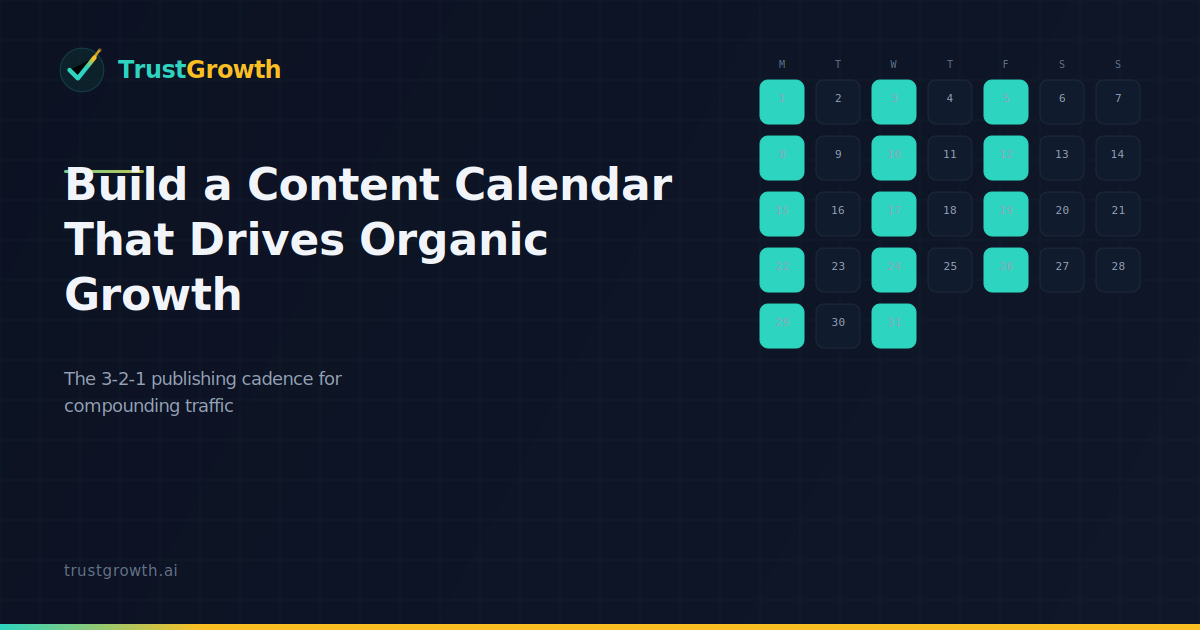
- 3 SEO articles per month — keyword-targeted, evergreen content
- 2 thought leadership pieces — original insights, data, or perspectives
- 1 product update — changelog, feature announcement, or case study
This gives you consistent output without burning out a small team.
Measure What Matters
Track these metrics monthly:
- Organic impressions — are more people seeing your content in search?
- Click-through rate — are your titles and descriptions compelling?
- Keyword rankings — are you moving up for target keywords?
- Backlinks acquired — is your content earning links naturally?
Don't obsess over page views. A post that ranks #3 for a high-intent keyword and converts visitors is worth more than a viral post that brings unqualified traffic.
Tools to Get Started
You don't need expensive enterprise tools. Start with:
- Google Search Console — free keyword and performance data
- TrustGrowth — automated E-E-A-T audits and content strategy
- A simple spreadsheet — track your calendar, assignments, and publication dates
The best content calendar is the one your team actually follows. Keep it simple, measure results, and iterate.
Know your site's real SEO score
Free GSC-verified audit, E-E-A-T scoring, and AI-powered content strategy.
Get Started Free