Audit & Scoring
FREE80+ checks across technical, performance and content, 27 E-E-A-T signals — and one score, judged from the evidence they file.
ExploreA scheduled audit across technical, performance, content, E-E-A-T and AI visibility — scored against your own Search Console, not a third-party scraper.
Read-only Google Search Console · about 60 seconds · no card, ever
Broken internal link on 2 pages is capping Technical. Fix with Groundcrew →
01 — Measure
One scheduled pass across every signal that decides whether you get found, then a score you can watch move.
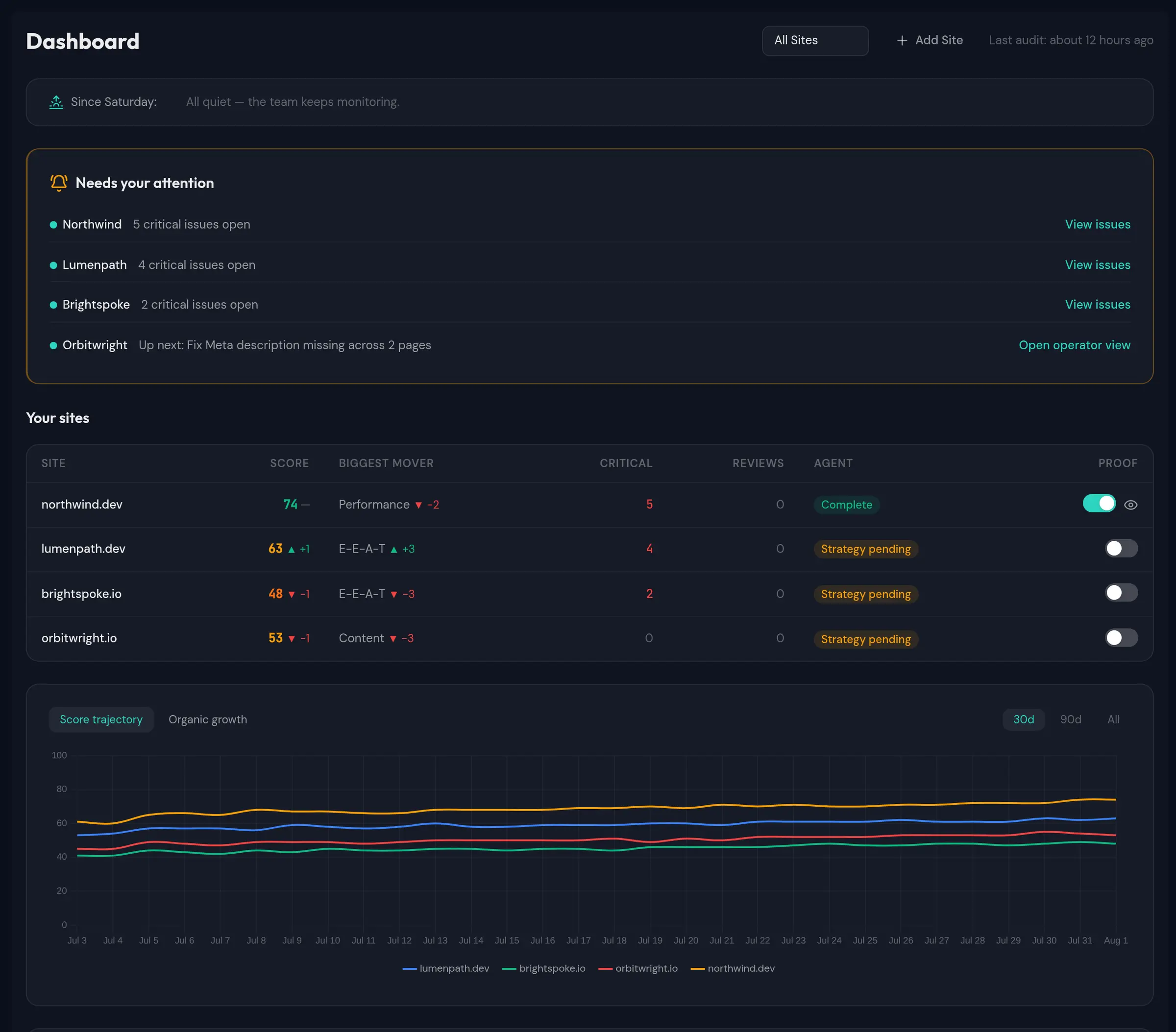
80+ checks across technical, performance and content, 27 E-E-A-T signals — and one score, judged from the evidence they file.
ExploreFive stages from crawler reach to whether Claude, GPT and Gemini name you unprompted.
ExploreYour SERP footprint and share of voice measured against a real competitor set.
ExploreBacklink profile, referring domains, link gap, and broken links worth reclaiming.
Explore02 — Fix
Groundcrew is open source and works with any LLM without an account. Wire it to live data over MCP on Starter and it reads the same evidence your team does.
Your agent reads a finding, patches the root cause in your repository, runs your tests, and prepares a pull request — and the next audit confirms the finding actually closed. Twenty open-source Markdown skills, MIT licensed.
curl -fsSL https://raw.githubusercontent.com/techwright-lab/groundcrew-seo/main/install.sh | bashThen ask your agent: "inspect this repo and fix one verifiable site defect." What Groundcrew does →
Connect the same agent over MCP and it fixes from your measured findings — the score, open issues, keyword gaps — instead of re-guessing from the page. Works in Claude, Cursor, VS Code, Codex, and any MCP host.
claude mcp add --transport http trustgrowth https://trustgrowth.ai/mcpOAuth opens in the browser — nothing to paste. Steps for every client →
03 — Verify
Every change lands against a dated baseline. Publish the result and let anyone check it.
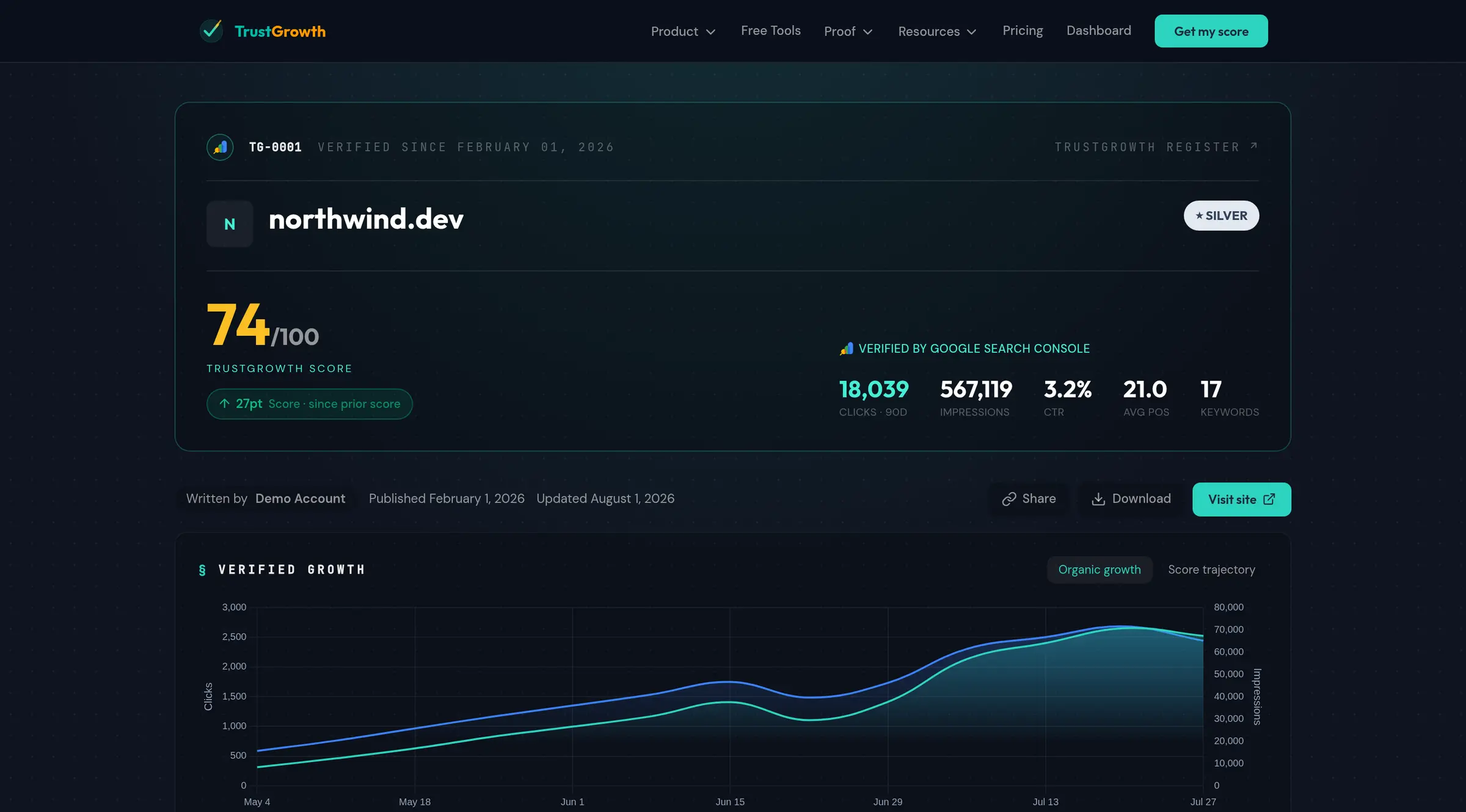
Leaderboard — updated daily
Every public proof page is ranked by its GSC-verified TrustGrowth Score — weak signals included.

atlasanatolia.com
TrustGrowth Score
52
TrustGrowth Score
45

inetsoftware.de
TrustGrowth Score
41
The AI team
Each one does a job you can name, on evidence you can check. The three still joining are built but not open — they are marked so you know what you are and are not buying.
Crawls your pages on schedule, checks 80+ data points, and files issues with the affected pages attached.
Maintains your keyword opportunities and competitor gaps from real search data, refreshed as it changes.
Turns audit gaps and keyword evidence into a site-specific strategy you can approve or send back with feedback.
Scores technical, performance, E-E-A-T, authority, and visibility signals daily into one trajectory you can inspect.
Builds a content calendar from your approved strategy, paced to what your site can sustain.
Draft briefs and long-form content from the calendar — always as drafts for your review, never straight to publish.
Reviews every draft against SEO, technical, and claim-safety checks before it reaches your approval queue.
The growth engine
Calendar, briefs and drafts are built but not yet open. No spam, no date promises.
How it's priced
Free · forever
Audit on Autopilot across technical, performance, content and E-E-A-T at essential coverage, plus the TrustGrowth Score and a public proof page for one site. Plus Groundcrew standalone to fix what it finds with your own agent.
Starter · $9/mo
Expanded coverage per site on Autopilot, keyword opportunities, competitor gaps and a monthly strategy — plus MCP and API access so Groundcrew reads your live data.
Pro · $49/mo
Advanced coverage per site on Autopilot, the full backlink profile with link gap and reclamation, SERP landscape and share of voice, and the complete five-stage AI visibility funnel.
Free covers one site. On Starter and Pro there is no site cap at all — credits, not a number of properties, are what meter usage. Add sites freely and top up only when you run more work than your plan grants.
Plans
Audit one site on Free — Audit on Autopilot with essential coverage. Starter widens that to expanded coverage and adds credit-powered research. Pro takes it to advanced coverage, with deeper research controls.
$0
0 credits/month · Audit on Autopilot
$9/mo
50 credits/month · Audit on Autopilot
$49/mo
300 credits/month · Audit on Autopilot
Add your site, connect Search Console with read-only access, and inspect the current baseline before deciding what to change.
Read-only Google Search Console access. We never modify your data.
