ACT ONE · MEASURE · RESEARCH & STRATEGY
A strategy is choices you can argue with.
Including the ones it didn't make. Every pillar comes with its evidence, every frequency with its confidence — and what was set aside stays visible instead of vanishing.
Your free score starts the evidence file; strategies build on it from Starter.
FROM A REAL STRATEGY
REAL OUTPUT-
chosen
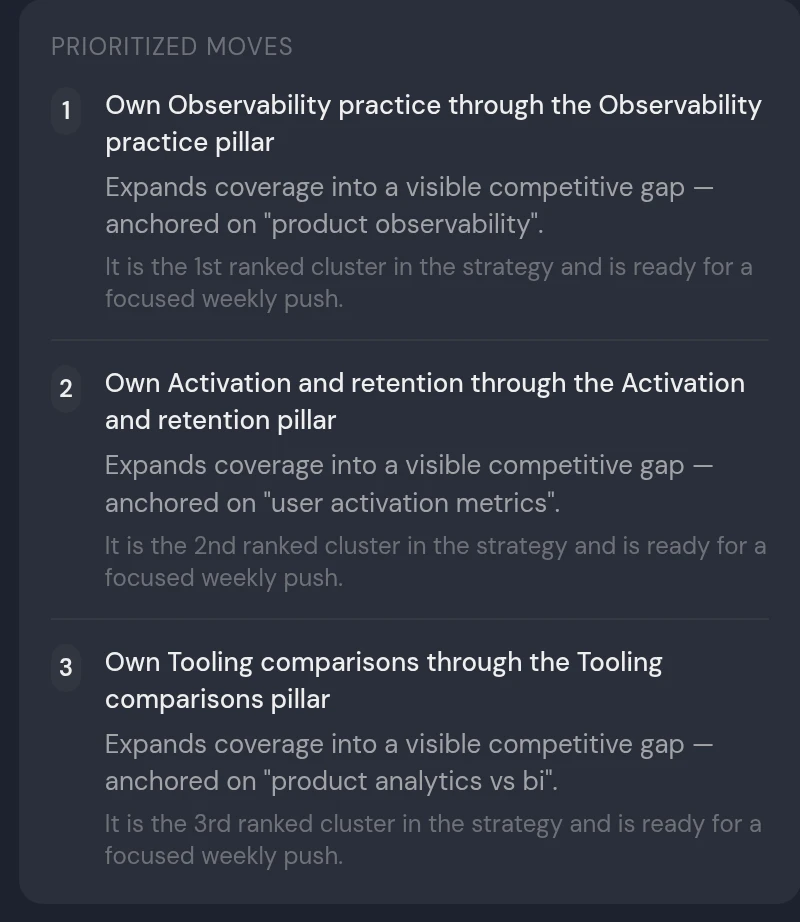
Own Observability practice — “expands coverage into a visible competitive gap — anchored on ‘product observability’.”
-
set aside · reversible
product analytics glossary— 740 searches · score 34 · retained in the evidence file
Choices, with their working shown
A strategy here is not a mood board. Each content pillar names the evidence that argued for it — the opportunity data, the competitor gap, the trust-signal hole — and the publishing frequencies come with confidence levels, not vibes. When the reasoning is thin, the strategy says so rather than dressing it up.
PILLAR 1 · CHOSEN
REAL OUTPUTOwn Observability practice
Anchor: “product observability” · ranked cluster #1 · “ready for a focused weekly push”
CHOSEN · HIGH CONFIDENCE
REAL OUTPUTBlog posts · 2/week
“Two long-form guides a week is the pace the current backlog supports.”
What it didn't choose stays visible
Measured opportunities that were considered and set aside remain in the dismissed ledger with their evidence intact. You can object, return one to the shortlist, and regenerate the strategy.
chosenOwn Observability practice — anchored on “product observability”, the 1st ranked cluster
chosenOwn Activation and retention — anchored on “user activation metrics”, the 2nd ranked cluster
chosenOwn Tooling comparisons — anchored on “product analytics vs bi”, the 3rd ranked cluster
set asideproduct analytics glossary — 740 searches and a 34.00 score stay on file
set asidesaas retention benchmarks — 2,600 searches and a 37.00 score stay on file
Reversible in Keyword Research — the Dismissed view restores any row to the shortlist; the reasoning lives with whoever dismissed it, the evidence lives here.
A visible rejection is a decision you can audit. An invisible one is a decision you have to trust.
You hold the pen on approval
The strategy ships as a proposal: Approve adopts it and the calendar follows; Regenerate sends it back with your context. Approval is yours — in the app, deliberately. Agents connected over the API can generate, read, and regenerate strategies, but adopting one is a human act.
STATE 1 · PROPOSAL
REBUILTstatus: pending_review · awaiting your decision
Actions: Approve · Regenerate — “approve the strategy to generate your content calendar from it.” Nothing executes before this.
↓ a human clicks Approve ↓

STATE 2 · APPROVED
REAL OUTPUTGenerated about 4 hours ago · Approved
Regenerate and Archive stay live — the decision is reopenable, never automatic.
Where the line falls
- Free
- THE EVIDENCE FILE — score, audits, and the measured signals strategies argue from. Research and strategy runs are not included on Free.
- Starter · $9
- RESEARCH + STRATEGY · STARTS HERE — keyword research, opportunities, and the strategy cycle with approval in your hands.
- Pro · $49
- ADDS THE FULLER SERP ARGUMENT — the SERP landscape: competitor set, Search map and daily data feeding sharper pillars and gap evidence.
WHAT THIS DOES NOT SAY
A strategy argues from measured evidence; it does not promise outcomes. Frequencies are recommendations with confidence levels, not commitments; opportunity scores rank evidence, they don't forecast traffic. And the record shows what was set aside — it does not claim the shortlist was exhaustive.
Frequently asked questions
Who writes the strategy?
The Strategist on your TrustGrowth team, arguing from your measured data — your opportunity rows, the competitor gaps, the trust-signal holes. It arrives as a proposal with its reasoning attached, not as a plan already in motion.
Does anything execute automatically once a strategy is generated?
No. Approval is a human act, taken in the app, deliberately. Agents connected over the API can generate, read and regenerate strategies; adopting one is not something they can do. Nothing downstream — no calendar, no draft — exists before you approve.
What evidence backs each pillar?
Each one names what argued for it: the opportunity data, the competitive gap, the anchor keyword and its ranked cluster. Publishing frequencies come with confidence levels rather than vibes, and when the reasoning is thin the strategy says so instead of dressing it up.
What happens to the ideas it did not choose?
They stay visible. Measured opportunities that were considered and set aside remain in the dismissed ledger with their evidence intact, and you can restore any of them to the shortlist and regenerate. A visible rejection is a decision you can audit; an invisible one is a decision you have to trust.
Do you forecast the traffic a strategy will produce?
No. Opportunity scores rank evidence; they do not forecast traffic, and frequencies are recommendations with a confidence level, not commitments. The record also shows what was set aside — it does not claim the shortlist was exhaustive.
Can I disagree with it?
That is what the surface is for. Regenerate sends the strategy back with your context, the dismissed view restores anything you think was wrongly set aside, and the approved state stays reopenable. A strategy is choices you can argue with, including the ones it did not make.
Is strategy included on Free?
No. Free gives you the evidence file strategies argue from — score, audits, and the measured signals. Research and strategy runs start at Starter.
Get my score
Strategies argue from your data. The score starts the file they'll argue from.
NEXT · THE LOOP CLOSES
Approved strategy becomes a calendar, drafts, and — when it ships — proof