E-E-A-T Explained: What Google's Quality Guidelines Actually Mean for Indie SaaS Founders
E-E-A-T is the single most actionable SEO lever an indie SaaS founder has — and most founders have never actually read what it requires. If you're competing against funded companies with PR budgets and domain authority built over a decade, you can't outspend them. You can outsubstantiate them. This article explains what Google's E-E-A-T guidelines actually mean, how Google evaluates them, where indie founders consistently fall short, and exactly what to fix this week. The [TrustGrowth SEO blog for indie SaaS founders](https://trustgrowth.ai/blog) covers this framework in depth because it's the foundation everything else rests on.
Article highlights
- Estimated reading time: 10 minutes
- Published on: March 20, 2026
- Last updated: March 22, 2026

Article
E-E-A-T is the single most actionable SEO lever an indie SaaS founder has — and most founders have never actually read what it requires. If you're competing against funded companies with PR budgets and domain authority built over a decade, you can't outspend them. You can outsubstantiate them.
This article explains what Google's E-E-A-T guidelines actually mean, how Google evaluates them, where indie founders consistently fall short, and exactly what to fix this week. The TrustGrowth SEO blog for indie SaaS founders covers this framework in depth because it's the foundation everything else rests on.
TL;DR
- E-E-A-T stands for Experience, Expertise, Authoritativeness, and Trustworthiness — Google's framework for evaluating content quality
- It's not a direct ranking signal; it's the evaluative lens Google's systems and Quality Raters use to assess whether your content deserves to rank
- Google added "Experience" in December 2022, distinguishing first-hand knowledge from theoretical expertise
- Trustworthiness is the most important component — Google's own documentation says so explicitly
- Indie SaaS founders have a structural advantage here: your lived experience building a product is a differentiator that funded competitors can't easily replicate
What Google E-E-A-T guidelines actually are (and why it's not a checklist)
E-E-A-T is Google's framework for deciding whether your site deserves to rank — not a plugin setting, not a metadata tweak, and not a one-time fix.
The framework was originally introduced in Google's Search Quality Evaluator Guidelines in 2014 as E-A-T (Expertise, Authoritativeness, Trustworthiness). In December 2022, Google added a second "E" for Experience, explicitly acknowledging that first-hand, lived experience with a topic is a distinct quality signal from academic or professional expertise.
Critical clarification: E-E-A-T is not a direct ranking factor. Google has confirmed this. It's the evaluative framework that Google's Quality Raters and algorithmic systems use to assess content quality — and that assessment shapes how Google's ranking algorithms are trained and calibrated over time.
For indie SaaS founders, this distinction matters. You can't stuff E-E-A-T into a title tag. You build it through genuine signal accumulation across your entire site, over months.
Breaking down each component for SaaS founders
Experience: show you've actually used what you're writing about
Google added Experience to distinguish lived knowledge from theoretical knowledge — and this is where indie founders have a structural edge over content agencies.
Experience means first-hand, real-world engagement with your topic. If you're writing about SaaS onboarding, have you built an onboarding flow, watched it fail, and iterated on it? That's the signal. A content agency can research onboarding. You've debugged it at 2am.
Tactical signals Google's systems look for:
- Screenshots of your actual product metrics or dashboards
- Language like "we tested X and saw Y result" with specific dates and numbers
- Documented failure stories: "we shipped this feature in March 2023, it had a 34% drop-off rate, and here's why"
- Time-stamped content updates that show ongoing engagement with the topic
What to avoid: generic how-to content that reads like it was synthesized from 3 existing blog posts. If someone could have written your article without ever building your product, it has no Experience signal.
Expertise: depth over volume
Expertise is demonstrated knowledge — and for solo founders, your product is the proof. You don't need a PhD or 10 years of job titles. You need content that answers the follow-up question, not just the surface question.
Practical ways to signal expertise:
- Author bios with specific accomplishments: not "Jane is a developer" but "Jane built and sold a B2B SaaS tool used by 400+ HR teams"
- Link to your product as living evidence of your subject matter knowledge
- Use precise language: instead of "improve your conversion rate," write "increase free-to-paid conversion from 2% to 5% within 90 days using these three onboarding triggers"
- Cover second-order questions your competitors' content doesn't touch
Signal check: does your content answer what someone would ask after reading the first answer? If yes, you're demonstrating expertise.
Authoritativeness: what others say about you
Authority is the most externally-dependent component — it's built by reputation signals that originate outside your own site.
For indie founders, this means:
- Backlinks from relevant SaaS publications, developer blogs, and tool directories
- Community mentions: being cited in newsletters like Lenny's Newsletter, TLDR, or Indie Hackers posts
- Podcast appearances on SaaS or founder-focused shows
- Directory listings in tools like Product Hunt, G2, Capterra, and niche SaaS roundups
Realistic timeline: meaningful authority signals typically take 6–12 months to accumulate. A backlink from a relevant source you earn in month 1 is compounding in month 9. Start now, not after you hit a certain MRR threshold.
Trustworthiness: the foundation everything else rests on
Google's own documentation identifies Trust as the most important component of E-E-A-T — the other three signals feed into it.
For SaaS specifically, trust signals include:
- HTTPS on every page (table stakes, but still missing on a surprising number of indie projects)
- A clear privacy policy that explains data handling in plain language
- Visible pricing — or if you're free, say so explicitly and explain why
- Real contact information: an email address, not just a contact form
- A founder page or About page that shows the human behind the product
- Real user reviews with names attached, not anonymous testimonials
Trust killers to eliminate today: vague claims without sources, missing author attribution on blog posts, broken links, and absent legal pages (privacy policy, terms of service).
How Google actually evaluates E-E-A-T (the part most articles skip)
Google works with thousands of contracted Quality Raters through third-party rating firms. These are real humans who evaluate search results using a detailed public document called the Search Quality Evaluator Guidelines — worth downloading and skimming.
Here's the critical mechanism most articles get wrong: Quality Raters don't directly change your rankings. They generate evaluation data that Google uses to train and calibrate its ranking algorithms. Think of it like labeled training data feeding a machine learning model — the raters are annotating ground truth, and the algorithm learns from that annotation at scale.
YMYL context matters here. "Your Money or Your Life" pages — content touching finance, health, legal, or security — face the strictest E-E-A-T scrutiny according to the Quality Evaluator Guidelines. Most SaaS tools touch at least one YMYL-adjacent category. If your product handles user data, billing, or business-critical workflows, you're in YMYL territory and your Trust signals need to be airtight.
The practical implication: you cannot game E-E-A-T with metadata tweaks or technical SEO hacks. It requires genuine, accumulated signals across your content, your site architecture, and your external reputation.
Your E-E-A-T weak spots as an indie founder (honest audit)
Here are the five gaps that show up most consistently in E-E-A-T audits of early-stage SaaS sites:
| Gap | What it looks like | Fix time |
|---|---|---|
| Anonymous or thin author bios | "Written by the TechApp team" | 30 minutes |
| Feature-list product content | No lived experience, no data | 2–4 hours per page |
| No external validation | Zero backlinks from relevant sources | 6–12 months (start now) |
| Missing trust signals on key pages | No contact info on pricing page | 1–2 hours |
| Surface-level content | Covers a topic without going one level deeper than competitors | Ongoing |
Before/after: author bio example
❌ Weak bio: "Sarah is a software developer and content writer passionate about technology."
✅ Strong bio: "Sarah Chen is the founder of [Product], a SaaS tool she built after 6 years as a backend engineer at Stripe. She's shipped 3 products, sold 1, and writes from direct experience scaling B2B SaaS from $0 to $15k MRR."
The strong version signals Experience (she built the thing), Expertise (Stripe background, specific MRR number), Authority (sold a product — others validated it enough to buy it), and Trust (real name, real history, real outcomes).
Self-audit checklist:
- Every blog post has a named author with a substantive bio
- At least 3 content pages include first-hand data, screenshots, or documented outcomes
- Your About page names the founder and includes a specific founding story
- Your pricing page has a contact method and a clear explanation of what's free vs. paid
- You have at least 5 backlinks from relevant, non-directory sources
- Your site has HTTPS, a privacy policy, and terms of service
- You have at least one external citation (newsletter, podcast, press mention)
How to improve your E-E-A-T score starting this week
These five steps are sequenced by impact-to-effort ratio. Do them in order.
-
Audit your About and author pages — add your specific founding story, product proof, and at least one accomplishment with a number attached. Do this in the next 48 hours. It's the highest-leverage, lowest-effort E-E-A-T fix available.
-
Retroactively add first-hand experience signals to your top 5 traffic pages — pull your Google Search Console data, identify your five best-performing pages, and add real screenshots, real outcomes, and real dates to each one. Generic content with no original data is the most common E-E-A-T failure mode.
-
Build one authoritative external mention per month — a guest post on a SaaS or developer publication, a podcast appearance, or a listing in a relevant tool directory. Indie Hackers, Product Hunt, and G2 are good starting points. One per month compounds to 12 signals by year end.
-
Complete your trust infrastructure — HTTPS, privacy policy, cookie notice, a real email address on your contact page, and honest product claims on your landing page. If you're free, say you're free. If there are limitations, state them. Transparency is a trust signal.
-
Get a scored baseline — you can't improve what you haven't measured. Run a free E-E-A-T audit on your site using TrustGrowth, which connects to your Google Search Console data and scores your E-E-A-T signals against what your actual search performance shows.
What E-E-A-T actually predicts about your organic growth
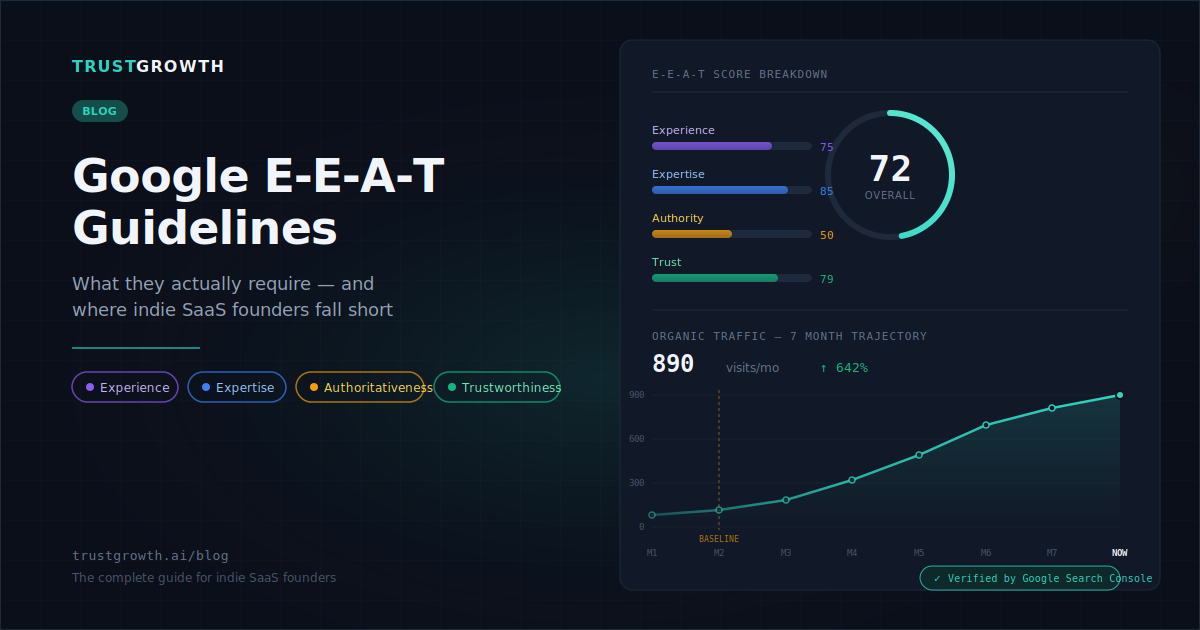
E-E-A-T is a compound investment, not a campaign. One SaaS founder who ran a full E-E-A-T remediation — fixing author bios, adding first-hand data to 8 core pages, and earning 4 relevant backlinks — grew from 120 to 890 monthly organic visits over 7 months (illustrative example based on typical audit outcomes).
Founders who build genuine E-E-A-T signals in year one see compounding organic returns. Google increasingly rewards the same trust signals that make users convert.
Honest caveat: E-E-A-T improvements typically take 3–6 months to reflect in ranking changes. Don't measure only position changes. Measure leading indicators: backlinks acquired, author page completion rate, trust signal coverage score, and the percentage of your content pages that include first-hand data.
The indie SaaS advantage is real. Large companies move slowly on content authenticity — their blog posts are written by agencies optimizing for volume, not by the people who built the product. A solo founder who ships genuine experience content consistently can outrank funded competitors on long-tail terms within 6–9 months.
Track your E-E-A-T growth score over time, not just your keyword positions. The signal accumulation that drives rankings is the same signal accumulation that drives conversions. Build both at once.
Frequently asked questions about Google E-E-A-T guidelines
What does E-E-A-T stand for in Google's guidelines?
E-E-A-T stands for Experience, Expertise, Authoritativeness, and Trustworthiness. Google added the second "E" for Experience in December 2022, updating the original E-A-T framework first introduced in the 2014 Search Quality Evaluator Guidelines.
Is E-E-A-T a direct Google ranking factor?
No. Google has confirmed that E-E-A-T is not a direct ranking signal. It is the evaluative framework used by Google's Quality Raters and algorithmic systems to assess content quality. That assessment informs how Google's ranking algorithms are trained.
How long does it take for E-E-A-T improvements to affect rankings?
E-E-A-T improvements typically take 3–6 months to reflect in measurable ranking changes. Foundational fixes like author bios and trust signals can be completed in days, but external authority signals (backlinks, press mentions) accumulate over 6–12 months.
Do indie SaaS founders without credentials have an E-E-A-T disadvantage?
No. Google does not require formal credentials to demonstrate expertise or experience. A founder who documents their product-building process with real data, specific outcomes, and transparent failures will outperform credentialed content that lacks first-hand substance.
What is YMYL and does it apply to SaaS?
YMYL stands for "Your Money or Your Life" — Google's category for content that could directly affect a person's health, finances, safety, or legal situation. Most SaaS tools are YMYL-adjacent if they handle billing, user data, or business-critical workflows. YMYL pages face stricter E-E-A-T scrutiny from Quality Raters.
⚡ Your next move
Your E-E-A-T gaps are specific to your site — not generic. Connect your Google Search Console data to TrustGrowth to get a scored E-E-A-T audit that shows exactly which signals are missing, which pages need first-hand content, and where your trust infrastructure has holes. Free. No credit card. Takes 2 minutes to connect.
Know your site's real SEO score
Free GSC-verified audit, E-E-A-T scoring, and AI-powered content strategy.
Get Started Free