E-E-A-T Explained: The 24 Signals Google Actually Cares About
Google's quality raters evaluate 24+ specific signals across Experience, Expertise, Authoritativeness, and Trustworthiness. Here's the complete breakdown of what they are and how to improve each.
Article highlights
- Estimated reading time: 4 minutes
- Published on: March 10, 2026
- Last updated: March 29, 2026

Article
Most E-E-A-T guides tell you to "add author bios" and "build backlinks." That's not wrong — it's just 10% of the picture. Google's quality raters evaluate dozens of specific signals when assessing Experience, Expertise, Authoritativeness, and Trustworthiness.
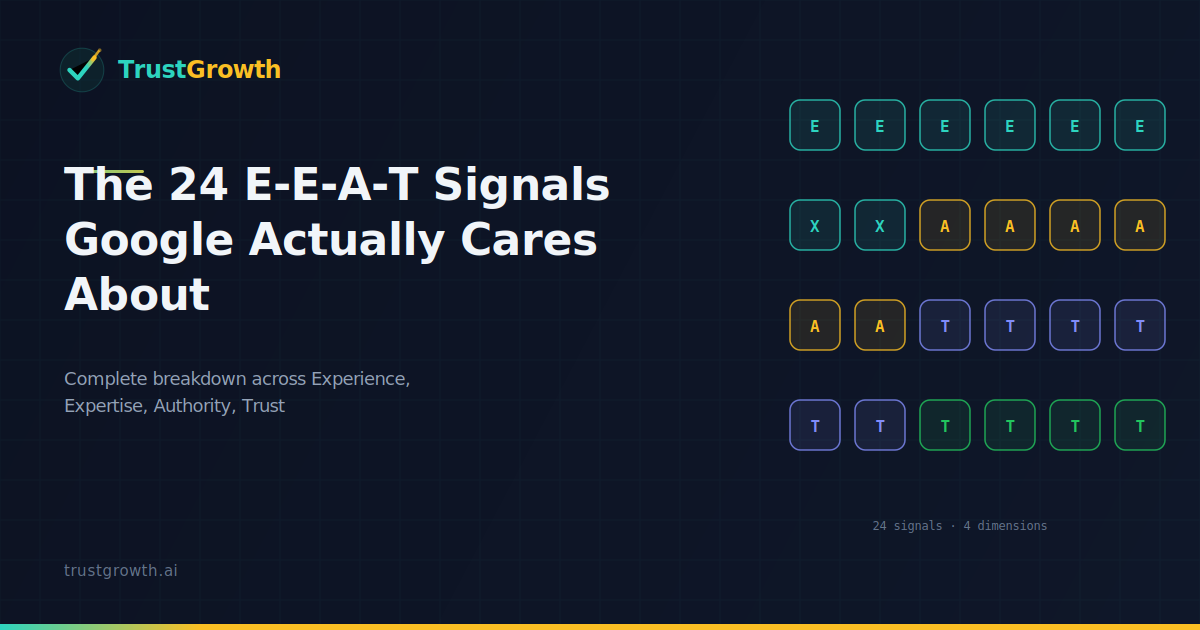
TrustGrowth audits 24 of them. Here's what they are and why they matter.
Why E-E-A-T Matters More in 2026
Google's Helpful Content system, the March 2024 core update, and the rise of AI-generated content have all pushed E-E-A-T signals higher in importance. Sites that demonstrate real human expertise and genuine trustworthiness are outperforming sites that just produce volume.
The challenge: E-E-A-T isn't a single ranking factor. It's a collection of signals that, together, tell Google whether your site is the kind of place it should send searchers to.
The 6 Experience Signals
Experience is the newest addition to the framework (added in December 2022). It asks: does this content reflect real, first-hand experience?
- Original data or research — Does your content reference data you've gathered, not just cited from others?
- Case studies with real results — Specific outcomes, not generic advice
- Product screenshots and demos — Evidence you actually use what you discuss
- Personal anecdotes — First-person accounts of relevant experiences
- Behind-the-scenes content — Showing your process, not just your conclusions
- Updated content timestamps — Demonstrating you revisit and verify information over time
The 5 Expertise Signals
Expertise evaluates whether the content creator knows the topic deeply.
- Author credentials — Formal qualifications, certifications, years of experience
- Author biography — Linked from every piece of content they write
- Content depth — Does it go beyond what's already freely available?
- Technical accuracy — No factual errors (especially important in YMYL topics)
- Citation of authoritative sources — Linking to primary sources, not just other blogs
The 7 Authoritativeness Signals
Authoritativeness is about recognition from your broader industry — the "outside-in" view.
- Backlink profile quality — Links from recognized, relevant publications
- Brand mentions — Unlinked mentions in industry content, podcasts, and press
- Social signals — Consistent presence and engagement on relevant platforms
- Publishing consistency — Regular content output over time (not bursts)
- Topic clustering — Deep coverage across a coherent topical area
- Contributed content — Guest posts, interviews, or quotes in industry publications
- Community engagement — Active participation in relevant communities
The 6 Trustworthiness Signals
Trustworthiness is foundational — without it, the other three dimensions mean less.
- HTTPS and security headers — Secure connection with proper security configuration
- Privacy policy and terms — Clearly linked and accessible
- Contact information — Real, findable contact details (not just a form)
- Transparent ownership — Who owns the site? Who wrote the content?
- Accurate factual claims — No misleading information or false promises
- Review integrity — If you show reviews, are they genuine?
Which Signals Matter Most?
Not all 24 carry equal weight, and weight varies by site type:
- YMYL sites (health, finance, legal): Expertise and Trustworthiness signals dominate
- E-commerce: Trustworthiness signals dominate (security, reviews, contact info)
- SaaS/Tech: Experience and Expertise signals matter most
- News/Media: Authoritativeness signals (brand mentions, contributed content)
How TrustGrowth Measures These Signals
TrustGrowth's audit pipeline checks all 24 signals and gives each a score. The signals are grouped by dimension, then rolled up into an overall E-E-A-T score.
More importantly, you get a prioritized fix list — the signals where you're weakest and where fixing them will have the most impact on your overall score.
Most sites have low-hanging fruit. The most common gaps we see:
- No author bios on blog posts (Expertise #8)
- Missing privacy policy or terms linked from footer (Trustworthiness #20)
- No organization structured data (Trustworthiness #23)
- No original data or research (Experience #1)
Start with the quick wins, then work up to the harder ones.
FAQ
What does E-E-A-T stand for?
E-E-A-T stands for Experience, Expertise, Authoritativeness, and Trustworthiness. Google added the first "E" (Experience) in December 2022, previously the acronym was E-A-T.
Is E-E-A-T a direct Google ranking factor?
E-E-A-T is not a single algorithmic ranking factor, but the signals that demonstrate E-E-A-T — backlinks, author credentials, trust indicators, content depth — do directly influence rankings.
How many E-E-A-T signals does TrustGrowth check?
TrustGrowth checks 24 E-E-A-T signals across all four dimensions: 6 Experience signals, 5 Expertise signals, 7 Authoritativeness signals, and 6 Trustworthiness signals.
What's the fastest way to improve E-E-A-T?
Start with Trustworthiness quick wins: HTTPS, linked privacy policy/terms, contact information. Then add author bios to all content. These are the fastest changes with the highest relative impact.
Know your site's real SEO score
Free GSC-verified audit, E-E-A-T scoring, and AI-powered content strategy.
Get Started Free