Why Estimated SEO Scores Are Lying to You (And What to Use Instead)
Ahrefs, Semrush, Moz — their scores are estimates, not Google's real data. Here's why that matters and what to use instead to measure your actual SEO performance.
Article highlights
- Estimated reading time: 4 minutes
- Published on: March 7, 2026
- Last updated: March 29, 2026

Article
Every SEO tool gives you a score. Domain Rating. Authority Score. SEO Health. Trust Flow. The names change, the numbers vary wildly, and none of them come from Google.
There's a hard truth the SEO industry doesn't talk about enough: the scores you see in Ahrefs, Semrush, Moz, and every other third-party tool are estimates based on their own proprietary data — not Google's actual signals. And in 2026, the gap between those estimates and reality is wider than ever.
How Third-Party SEO Scores Are Built
Tools like Ahrefs and Semrush work by crawling the web and building their own index. From that index, they estimate:
- Domain authority — based on backlink quantity and quality in their index
- Organic traffic — inferred from keyword rankings multiplied by estimated CTR curves
- Keyword difficulty — modeled from SERP competition in their database
None of this comes from Google. Google's own data — what people actually search, how often your pages appear, how many people click — lives in Google Search Console, and it's only accessible to site owners.
The Data Discrepancy Problem
Here's how bad the estimates can get:
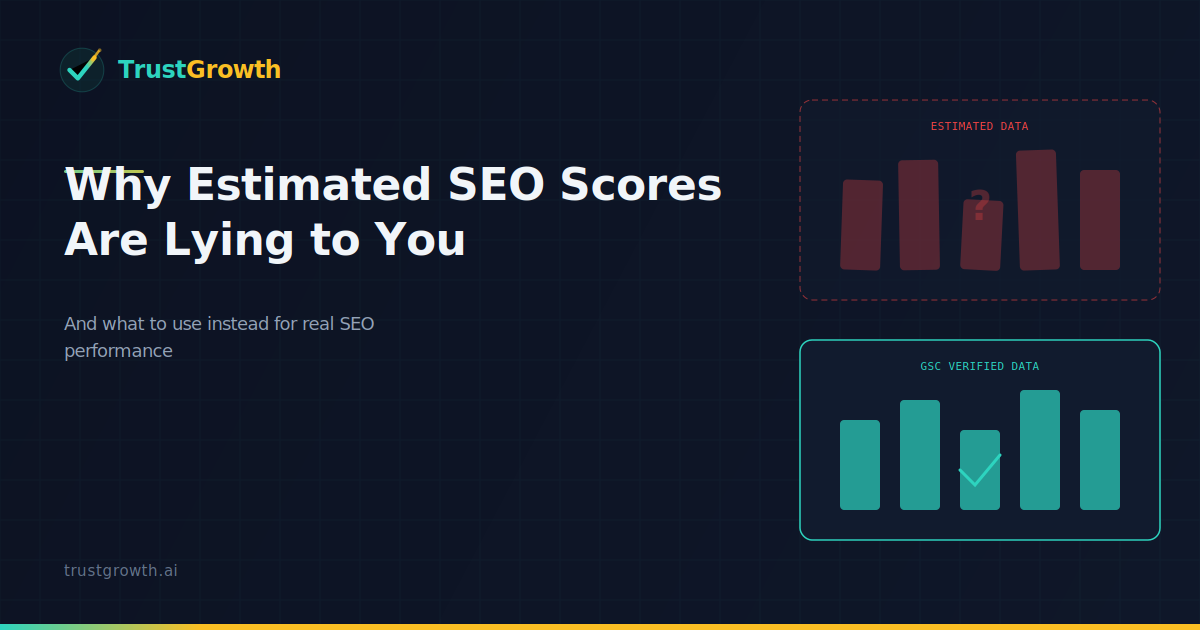
A study analyzing 1,000 websites found that Semrush traffic estimates deviated from actual GSC data by an average of 67%. For newer sites, niche sites, or sites with unusual traffic patterns, the deviation can exceed 200%.
Why? Because third-party tools:
- Don't see branded searches (a huge chunk of most sites' traffic)
- Miss long-tail keyword traffic that doesn't appear in their keyword databases
- Undercount traffic from queries with low search volume data
- Can't account for SERP feature clicks (AI overviews, featured snippets, etc.)
What This Means in Practice
Imagine you're comparing two approaches to your content strategy. One increases your Ahrefs traffic estimate by 30%. The other improves your actual GSC clicks by 20%.
If you're optimizing for the estimate, you might pick the wrong strategy.
This isn't hypothetical. Teams routinely:
- Overestimate competitor traffic by 2-3x based on tool estimates
- Abandon content that's actually driving GSC traffic because the tool doesn't show it
- Chase high-DA backlinks that don't move GSC positions at all
What Actually Works: GSC-Verified Data
Google Search Console gives you the real numbers:
- Impressions: How many times your pages appeared in search results
- Clicks: How many people actually visited your site from search
- Average position: Your real ranking, averaged across all searches
- CTR: Your actual click-through rate from search results
This data is from Google. Not estimated. Not modeled. Actual.
The problem is that GSC data is hard to work with. It's spread across dates, properties, and pages. There's no single growth score, no trend line, no benchmark against industry standards.
Enter GSC-Verified Growth Scores
This is exactly what TrustGrowth was built to solve.
Instead of estimating your SEO performance from third-party data, TrustGrowth connects to your Google Search Console and computes your growth score from actual GSC data. Every metric is verified — not estimated.
Your TrustGrowth score reflects:
- Real keyword growth from your GSC data
- Actual traffic trends, not modeled estimates
- True E-E-A-T signals from your site's actual structure and content
When your score goes up, it means something real happened. When it goes down, you know to investigate something concrete.
The Takeaway
Third-party SEO scores have their uses. Competitive benchmarking, link prospecting, general directional guidance. But for understanding your own site's performance? There's no substitute for the data Google actually has.
Stop optimizing for estimates. Start measuring what's real.
Connect your Google Search Console to TrustGrowth and get your first GSC-verified growth score in under 60 seconds.
FAQ
Are third-party SEO scores completely useless?
Not entirely. They're useful for competitive research (comparing sites relative to each other), link prospecting, and getting a rough sense of a domain's authority. But they shouldn't be used to measure your own site's actual performance — that's where GSC data is far superior.
Why can't SEO tools access Google's data directly?
Google doesn't share its search index or query data publicly. Tools build their own indexes by crawling the web and use sampling techniques to estimate search volumes and rankings. Only site owners can access their actual GSC data.
What's the difference between impressions and traffic?
Impressions are how many times your page appeared in search results. Traffic (clicks) is how many people actually visited your site. The ratio between them is your CTR. Third-party tools estimate impressions from keyword data; GSC shows your actual impressions and clicks.
How accurate are third-party traffic estimates?
Studies show deviations of 50-200% from actual GSC data, varying by site type and niche. Newer sites, niche sites, and sites with heavy branded traffic tend to have the least accurate estimates.
Know your site's real SEO score
Free GSC-verified audit, E-E-A-T scoring, and AI-powered content strategy.
Get Started Free