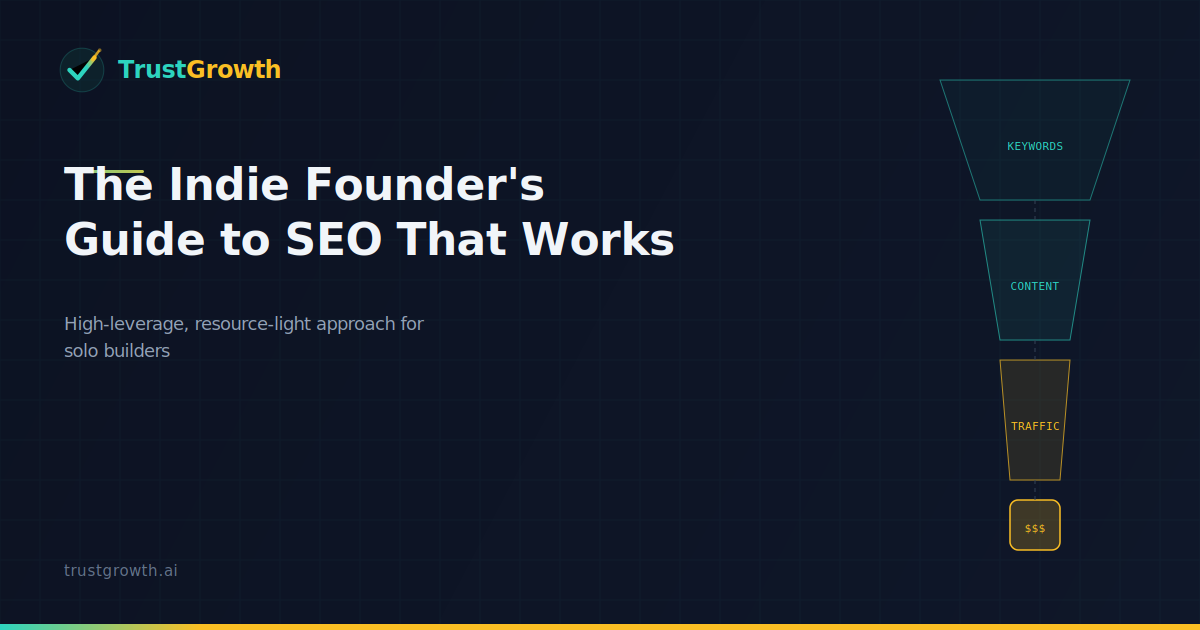
The Indie Founder's Guide to SEO That Actually Works
SEO advice written for enterprise teams doesn't work for indie founders. Here's the high-leverage, resource-light approach that actually builds organic traffic when you're working alone.
Article highlights
- Estimated reading time: 4 minutes
- Published on: March 16, 2026
- Last updated: March 29, 2026

Article
Most SEO advice is written for companies with dedicated content teams, $5k/month tool budgets, and six months to wait for results. If you're an indie founder, that advice doesn't fit.
You're working alone or with a tiny team. You need to move fast. You can't afford to bet months of work on a strategy that might not pan out. You need the highest-leverage SEO moves for a resource-constrained operation.
Here's what actually works.
Start With What You Know
The biggest advantage indie founders have over big companies: you know your customers. You've talked to them. You understand their problems at a level that a content agency never will.
Use that advantage. The best SEO content comes from:
- Customer questions you answer repeatedly — these are search queries waiting to happen
- Problems you solved in your product — document the problem and solution, not just the feature
- Your own journey — build-in-public content consistently outperforms generic how-to articles
Your first 10 blog posts should come from conversations you've already had.
The Long-Tail First Strategy
Don't start with high-volume keywords. You won't rank for them.
Instead, map the longtail:
- "how to [specific problem your product solves]"
- "[your tool] vs [competitor] for [use case]"
- "[your niche] [common problem] [year]"
Long-tail keywords have lower competition, clearer user intent, and convert better. A visitor who searched "how to audit E-E-A-T for a SaaS site" is a much better prospect than someone who searched "SEO."
Practical approach: Write 2-3 articles per month. Each one targets a different long-tail keyword. After 6 months, you'll have 12-18 articles covering different facets of your problem space. That's a topical authority foundation.
The 20-Minute Technical SEO Setup
Get technical basics right once, then forget about it. For a standard Rails/Next.js/WordPress site, you need:
- Verify in Google Search Console — free, takes 5 minutes, gives you the only data that matters
-
Submit your sitemap —
yoursite.com/sitemap.xmlin GSC - Check robots.txt — make sure you're not accidentally blocking pages
- Install basic schema — Organization + WebSite at minimum
- Optimize page speed — compress images, use WebP, check your LCP
That's 80% of technical SEO for most indie SaaS products. You can do it in an afternoon.
Content Strategy for One-Person Teams
The 3-1-1 cadence works for solo founders:
- 3 evergreen SEO articles per month — keyword-targeted, answer specific questions
- 1 build-in-public post — what you shipped, what broke, what you learned
- 1 product update — new feature, improvement, or customer story
That's 5 posts per month. Sustainable, strategic, and covers the three types of content that build both SEO and community.
Don't publish daily. Quality beats quantity at every stage. One excellent 1,500-word article beats five 300-word posts every time.
E-E-A-T for Solo Founders
Good news: indie founders have a natural advantage on Experience signals. You're the builder. You have firsthand knowledge. Use it.
- Put your name and face on your content — author bio on every post
- Link your personal Twitter/LinkedIn — social proof that you're a real person
- Show your build process — screenshots, decisions, failures
- Reference real customer conversations (with permission) — nothing demonstrates experience like "we had 20 customers ask about this, here's what we found"
Measuring What Matters (Without Paying for Tools)
You don't need Ahrefs or Semrush at the start. You need Google Search Console.
Weekly, check:
- Are impressions growing? (Are more people seeing your content?)
- Are clicks growing? (Are people choosing to visit?)
- Which queries are getting impressions but few clicks? (These need better title/meta)
Monthly, look at:
- Your top 10 queries by impressions — are you ranking higher this month?
- New queries you're appearing for — what new topics are you becoming relevant for?
Add TrustGrowth when you want a single score that tracks your overall SEO health over time, benchmarked against your baseline.
The Timeline Reality Check
SEO takes time. Realistic expectations for indie founders:
- Month 1-2: Setup, first few posts, minimal traffic from SEO
- Month 3-4: First rankings appearing, GSC showing impressions
- Month 5-6: Consistent traffic from long-tail terms, first keyword movers
- Month 8-12: Compounding effect kicks in, organic traffic becomes meaningful
The founders who succeed at SEO aren't the ones with the biggest budgets. They're the ones who publish consistently for 12+ months. Set a sustainable cadence and stick to it.
FAQ
What's the minimum viable SEO setup for a new indie product?
Google Search Console connected, XML sitemap submitted, robots.txt checked, basic Organization schema installed, images compressed. That's it. Takes one afternoon and sets the foundation for everything else.
How long before SEO starts driving meaningful traffic?
For a new domain with consistent publishing, expect 6-8 months before organic traffic becomes significant. Long-tail keywords can show results faster (3-4 months), but meaningful traffic typically requires 6+ months of consistent effort.
Do I need paid SEO tools as an indie founder?
No, especially at the start. Google Search Console gives you the data that actually matters — your real impressions, clicks, and rankings. Paid tools become useful when you need competitive research or large-scale keyword data, typically 6-12 months in.
How many blog posts do I need before SEO starts working?
There's no magic number, but 10-15 well-targeted posts covering different facets of your problem space is a reasonable foundation. Focus on quality and keyword targeting over quantity.
Know your site's real SEO score
Free GSC-verified audit, E-E-A-T scoring, and AI-powered content strategy.
Get Started Free