Core Web Vitals in 2026: What Changed and What Still Matters
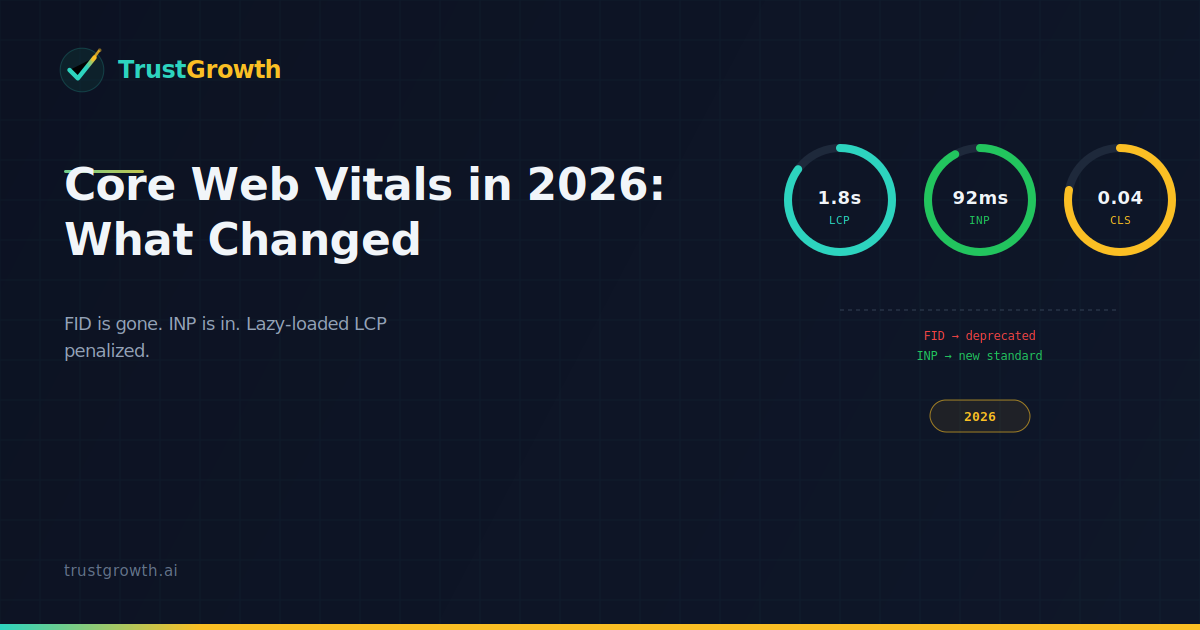
FID is gone. INP is in. Lazy-loaded LCP images are now penalized. Here's everything that changed in Core Web Vitals since 2022 and how to optimize for the metrics that actually matter in 2026.
Article highlights
- Estimated reading time: 4 minutes
- Published on: March 13, 2026
- Last updated: March 29, 2026

Article
Core Web Vitals have been a ranking factor since May 2021. In that time, Google has made significant changes — dropped FID, introduced INP, refined thresholds, and changed how they interact with AI-generated search results. If you haven't revisited your CWV strategy since 2022, you're optimizing for metrics that no longer exist.
Here's what's current.
The Current Three Metrics
LCP — Largest Contentful Paint
What it measures: How fast the main content of your page loads.
Good threshold: Under 2.5 seconds
Needs improvement: 2.5 – 4.0 seconds
Poor: Over 4.0 seconds
LCP is usually your hero image, above-the-fold text block, or video thumbnail. The most common culprits for slow LCP:
- Unoptimized images (missing WebP, wrong sizes, no
fetchpriority="high") - Render-blocking resources (CSS/JS loaded synchronously in
<head>) - Slow server response time (Time to First Byte above 600ms)
- No CDN for static assets
2026 note: Google's LCP algorithm now better accounts for lazy-loaded images. If your LCP element uses loading="lazy", that's now penalized more heavily.
INP — Interaction to Next Paint
What it measures: How fast your page responds to user interactions.
Good threshold: Under 200ms
Needs improvement: 200 – 500ms
Poor: Over 500ms
INP replaced FID (First Input Delay) in March 2024. The key difference: FID only measured the first interaction, while INP measures all interactions and reports the worst one.
This matters because a page can have fast first-load feel but sluggish interactions when scrolled or used — INP catches that.
Common INP culprits:
- Heavy JavaScript frameworks with large event listeners
- Long tasks (>50ms) blocking the main thread
- Third-party scripts (analytics, chat widgets, ad scripts)
- Unoptimized React/Vue re-renders
CLS — Cumulative Layout Shift
What it measures: How much the page layout shifts unexpectedly during load.
Good threshold: Under 0.1
Needs improvement: 0.1 – 0.25
Poor: Over 0.25
CLS hasn't changed significantly in threshold, but Google's measurement window has been refined. Content that shifts after user interaction (like expanding accordions) is now excluded from CLS calculation — only unexpected shifts count.
Still-common CLS causes:
- Images without
widthandheightattributes - Ads or embeds with reserved space too small for actual content
- Web fonts causing text reflow (FOUT/FOIT)
- Late-loading banners, cookie notices, and chat widgets
What Changed Since 2022
| Metric | 2022 | 2026 |
|---|---|---|
| INP | Not measured | Core metric |
| FID | Core metric | Removed |
| LCP lazy loading | Allowed | Penalized |
| CLS interaction shifts | Counted | Excluded |
| AI Overview impact | N/A | Reduces CTR for some queries |
How AI Overviews Affect the Equation
In 2026, many queries show Google's AI Overview at the top of results. This has two CWV implications:
- Zero-click searches have increased — even if your CWV is perfect, some traffic may not materialize because the answer appears in the AI Overview
- CWV still matters for clicks that happen — once a user does click through from a search result (especially after being unsatisfied with an AI Overview answer), their page experience directly affects whether they stay or bounce
The implication: optimize CWV not just for rankings, but for post-click retention. Fast, stable pages reduce bounce rate and increase the odds of re-engagement.
Checking Your CWV
Three places to check:
- Google Search Console → Core Web Vitals report (field data from real users)
- PageSpeed Insights — lab + field data for specific URLs
- TrustGrowth audit — automated check across your key pages with prioritized fixes
The most important thing: use field data, not lab data, for rankings. Google uses Chrome User Experience Report (CrUX) data — real user experiences — not Lighthouse scores. A perfect Lighthouse score doesn't guarantee good CWV field data.
Quick Wins for 2026
- Compress and convert images to WebP — biggest LCP improvement for most sites
-
Add
fetchpriority="high"to your LCP image — often a 200-400ms improvement -
Remove
loading="lazy"from above-the-fold images — now penalized for LCP - Audit third-party scripts — each one adds INP risk
- Set explicit width/height on all images — eliminates most CLS
FAQ
What happened to FID (First Input Delay)?
Google retired FID as a Core Web Vital in March 2024, replacing it with INP (Interaction to Next Paint). INP is a better measure of overall interactivity because it measures all user interactions, not just the first one.
What is a good Core Web Vitals score?
Good thresholds: LCP under 2.5s, INP under 200ms, CLS under 0.1. These must be met by at least 75% of your real user experiences (field data from CrUX) to be considered "good" by Google.
Does Lighthouse score affect rankings?
No. Google uses field data from the Chrome User Experience Report (CrUX), not Lighthouse lab scores. A perfect Lighthouse score doesn't guarantee good CWV field data. Always check your actual field data in Google Search Console.
How do AI Overviews affect Core Web Vitals importance?
AI Overviews haven't reduced the importance of CWV for pages that do receive clicks. In fact, as zero-click searches increase, every click becomes more valuable — and a fast, stable page experience is critical for retaining those visitors.
Know your site's real SEO score
Free GSC-verified audit, E-E-A-T scoring, and AI-powered content strategy.
Get Started Free