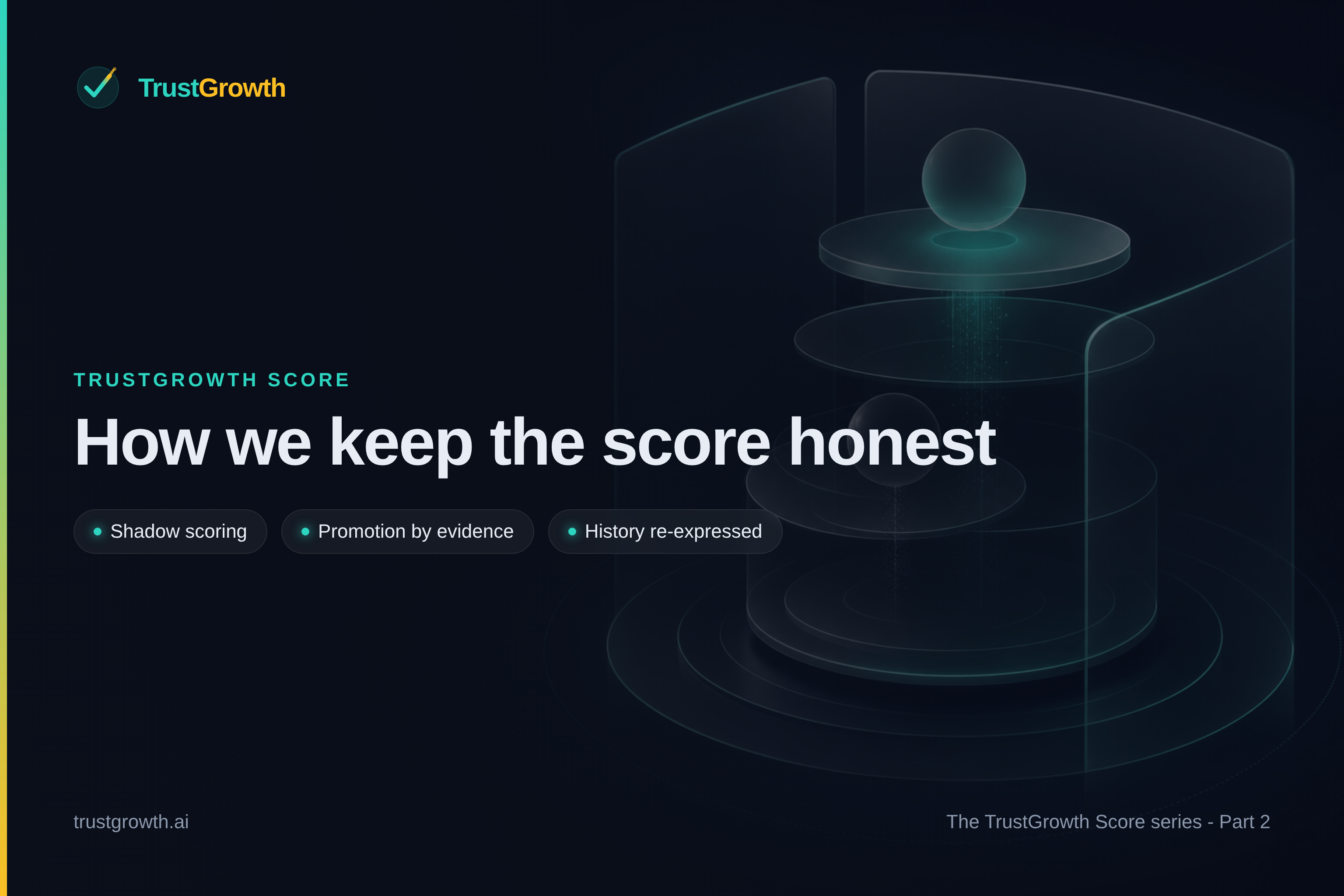
How we keep the score honest
A score that never changes goes stale. One that changes silently betrays trust. Inside the champion/challenger engine behind the TrustGrowth Score: challengers scored in shadow on real sites, promotion only by evidence, history re-expressed so the number never drifts under your feet.
Article highlights
- Estimated reading time: 5 minutes
- Published on: July 3, 2026
- Last updated: July 3, 2026
Article
In the first piece in this series, we made a promise that should worry you a little: the TrustGrowth Score is designed to keep evolving.
That's a strange thing to say about a number you're asking people to trust. A score that changes its own definition sounds like a moving target — and a moving target is exactly what a trust score must never be.
So this piece is about the machinery that resolves that tension. It's the part of TrustGrowth we're proudest of, and the part you'd normally never see.
The dilemma every score faces
A scoring methodology has two ways to die.
It can freeze: lock the definition on day one and never touch it. That preserves consistency, but the web doesn't hold still — AI systems now answer questions that used to be searches, signals that mattered five years ago matter differently today. A frozen score gets slowly, politely wrong.
Or it can drift: quietly tweak the recipe whenever the maintainers think of something better. The score stays current — and becomes unfalsifiable. Your number dropped this week. Did your site get worse, or did the definition change? You can't know. Every silent tweak spends trust the score can't earn back.
Most scores pick drift, because drift is invisible and freezing is embarrassing. We wanted a third option.
Champion and challengers
The TrustGrowth Score runs on a system borrowed from a field where getting a number wrong costs real money: credit and fraud modeling. It's called champion/challenger.
The champion is the formula behind the public score — the one number everyone sees, on every site, computed the same way every day.
Challengers are candidate improvements: a new pillar earning its way in, a better way to read a signal, a fairness fix for young sites. Every challenger runs in shadow: computed daily, on real sites, against real data, right alongside the champion — recorded, compared, and never shown as the public number.
A challenger doesn't get promoted because it's clever. It gets promoted because weeks of side-by-side evidence show it judges sites more fairly and more usefully than the current champion. Until then, it's an opinion with a scoreboard.
Here's the honest reason we built this discipline in from day one, when quietly editing the formula would have been so much cheaper: SEO and growth are not solved disciplines. The open questions outnumber the answered ones, and they change faster than ever now that AI systems sit between websites and the people searching. It's hardest on exactly the people we build for — founders with little SEO or marketing experience, trying to grow a product while still building it and selling it. And the ecosystem's response has been to multiply sources of truth: every tool and framework with its own definitions, its own meanings, each new "answer" adding to the pile of questions.
We won't pretend we're the exception. We dogfood our own products through this same system, and we're nowhere close to having all the answers. What we decided we could build is the machinery for finding them: an experimentation harness that runs competing definitions against real sites and real deltas — day over day, week over week, month over month — and lets evidence, not opinion, decide what the score should be. Maybe that's how this discipline eventually gets standardized. At minimum, it's how we stop guessing.
Promotion is an event, not an edit
When a challenger wins, replacing the champion is a deliberate, reviewed act — with an impact preview showing exactly how scores would shift before anything changes. Nobody adjusts the public score by tweaking a config on a quiet Tuesday. That's a governance choice, not a technical accident: the score's definition is treated like something people rely on, because it is.
And when the method does improve, we do the expensive honest thing: history gets re-expressed under the new method. Your score's past and present are always computed the same way, so a change in the number means your site changed — never that we quietly swapped rulers mid-measurement. The alternative — new method going forward, old method in the archive — leaves every chart lying at the seam. We'd rather recompute.
You've already seen this system working
Here's the part that makes this more than theory: it's running right now, in public view. The newest pillars of the score — authority and visibility, which we introduced in the first piece — are challengers today: computed daily in shadow across real sites, building up their side-by-side evidence, while the public number stays on the proven champion. When they've earned promotion, that's how they'll arrive — and you're reading about it before it happens, not after.
That's what "the score keeps evolving" actually means in practice. Not instability — staging. New ideas prove themselves on the bench before they touch the number you see.
What this buys you
If you put a TrustGrowth Score on your site, this machinery is the fine print working in your favor:
- The number can't drift silently. Definition changes are deliberate, previewed, and leave a re-expressed, consistent history.
- The number can't freeze either. There is always a bench of challengers trying to out-judge the champion, so the score keeps up with how trust actually works on today's web.
- Experiments never leak. We can be aggressive about testing new ideas precisely because testing happens in shadow, not on your public number.
A score you can trust isn't one that never changes. It's one that can show you how it changes, and why. That's the standard we've set for ourselves — and as always, our own sites wear the same score in public.
Next in the series: the pillars themselves, one by one — starting with the one Google literally wrote down and most tools still ignore: E-E-A-T.
The TrustGrowth Score series explains what our score measures and why — every pillar, every reason. New pieces weekly.
Know your site's real SEO score
Free GSC-verified audit, E-E-A-T scoring, and AI-powered content strategy.
Get Started Free