The pillar Google wrote down
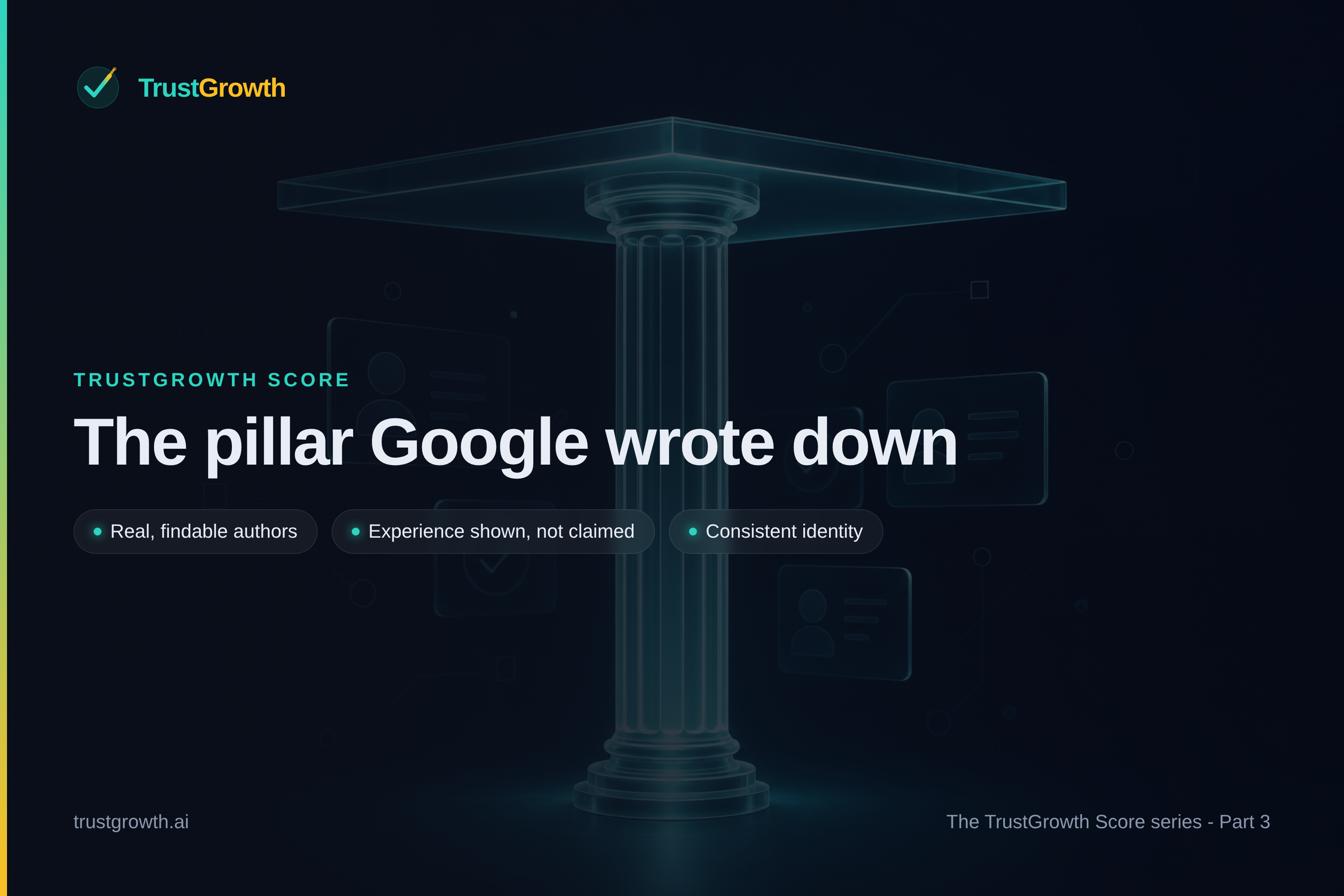
E-E-A-T - Experience, Expertise, Authoritativeness, Trustworthiness - is the one signal family Google explicitly documented, and the one most sites and tools still skip. What the TrustGrowth Score's E-E-A-T pillar measures: would a careful stranger believe you?
Article highlights
- Estimated reading time: 5 minutes
- Published on: July 4, 2026
- Last updated: July 4, 2026
Article
Search optimization mostly means reverse-engineering a black box. Google doesn't publish its ranking factors, so an entire industry guesses at them — and sells the guesses.
Except once. For one family of signals, Google did something it almost never does: it wrote down what it wants. In its Search Quality Rater Guidelines — the manual given to the thousands of human reviewers who evaluate search results — Google spells out a framework called E-E-A-T: Experience, Expertise, Authoritativeness, Trustworthiness.
It's the rare open-book test in SEO. And it's the test most sites — and most tools — still skip. E-E-A-T is one of the pillars of the TrustGrowth Score. This is what it measures, and why.
What this pillar measures
Strip away the acronym and E-E-A-T asks one question: would a careful stranger believe you?
Not "is your content good" — that's the content pillar's job. E-E-A-T is about whether the people and organization behind the content can be found, verified, and believed. When our system evaluates this pillar, it's looking at the site the way a skeptical human rater would:
- Who wrote this? Is there a named, findable human behind the content — real bylines, author pages, structured author markup that machines can verify — or does everything trace back to nobody?
- Who runs this? Can a stranger find out who operates the site, how to reach them, and what the rules are — or is the organization a logo with no address?
- Why should anyone believe them? Is experience demonstrated — first-hand detail, real usage, specifics only a practitioner would know — or merely claimed with adjectives?
- Does the site behave like something trustworthy? The unglamorous plumbing: secure connections, honest policies, consistent identity from page to page.
One thing we don't do: pretend to measure what we haven't checked. Some trust signals are hard to verify automatically, and when a signal hasn't been checked yet, it sits out of the pillar's judgment entirely rather than silently counting against you — the same honesty-about-unknowns rule the whole score follows.
Why it earned its way into the score
Three reasons, in escalating order of urgency.
First, it's the closest thing to ground truth we have. Nearly everything else in SEO is inferred from the outside. E-E-A-T comes from Google's own documentation of what its human raters reward. When the examiner hands out the grading rubric, you weight it accordingly.
Second, it can't be inferred from the other pillars. A site can be technically flawless, fast, and full of well-structured content — published by nobody, operated by nothing, verifiable nowhere. That configuration is precisely what the other pillars can't see, and increasingly what both search engines and readers punish.
Third — and this is the AI-era escalation — machine trust is becoming the gate in front of human trust. When AI systems assemble answers, they choose sources. A synthesizer deciding which of a thousand pages to believe leans hard on exactly these signals: identifiable authorship, verifiable organizations, corroborated identity. The web is filling with content that no one stands behind; being someone is becoming the scarcest signal of all. E-E-A-T used to be a quality bar. It's turning into the price of admission.
What "good" looks like
You don't need celebrity authors or a Wikipedia page. Directionally, a site that scores well here looks like this:
- Content signed by real humans. Named authors with real author pages — who they are, why they're credible on this topic — and identity markup that lets machines confirm what humans can read.
- An organization that's findable in seconds. Who runs the site, how to contact them, what the policies are. Boring pages, disproportionate trust.
- Experience shown, not asserted. "We migrated three production databases and here's what broke" outranks "we are passionate experts in data infrastructure" in every way that matters.
- One consistent identity everywhere. The same names, the same story, on the site and off it — so corroboration accumulates naturally instead of contradicting itself.
Common ways sites get it wrong
The ghost site. Solid product, decent content, and no evidence a human being is involved anywhere. No bylines, no about page, support behind a form. Every trust question a stranger might ask gets silence.
The "admin" byline. Content technically has an author — named admin, or a brand name pasted where a person should be. It reads as "no one specific will stand behind this," which raters treat accordingly.
Expertise by adjective. "Industry-leading experts with decades of experience" — claimed in the footer, demonstrated nowhere. Raters are explicitly instructed to look for evidence, and adjectives aren't evidence.
E-E-A-T as a checklist afterthought. One rushed about page, an auto-generated author bio, done. But this pillar measures identity plumbing, not page existence — thin theater is legible as theater, to humans and machines alike.
The AI-era trap: manufactured people. Generating a plausible author persona now takes one prompt, and it's the worst trade on this list — a fabricated expert converts your trust problem into a fraud problem. Detection keeps improving, and the penalty for being caught inventing humans is categorically worse than the penalty for being a small, real team. The boring fix wins: be findable, be specific, be an actual person.
All five failures collapse into the same root cause: treating "who's behind this?" as a formality instead of the question. It isn't a formality. It's the pillar.
As with every pillar in this series: this is the reasoning, not the arithmetic — the formula is designed to keep evolving, the reasoning is what we commit to. And our own sites wear this score in public, E-E-A-T pillar included.
Next in the series: Technical health — the pillar that decides whether search engines can even use your site.
The TrustGrowth Score series explains what our score measures and why — every pillar, every reason. New pieces weekly.
Know your site's real SEO score
Free GSC-verified audit, E-E-A-T scoring, and AI-powered content strategy.
Get Started Free