Understanding E-E-A-T Signals for SaaS Websites
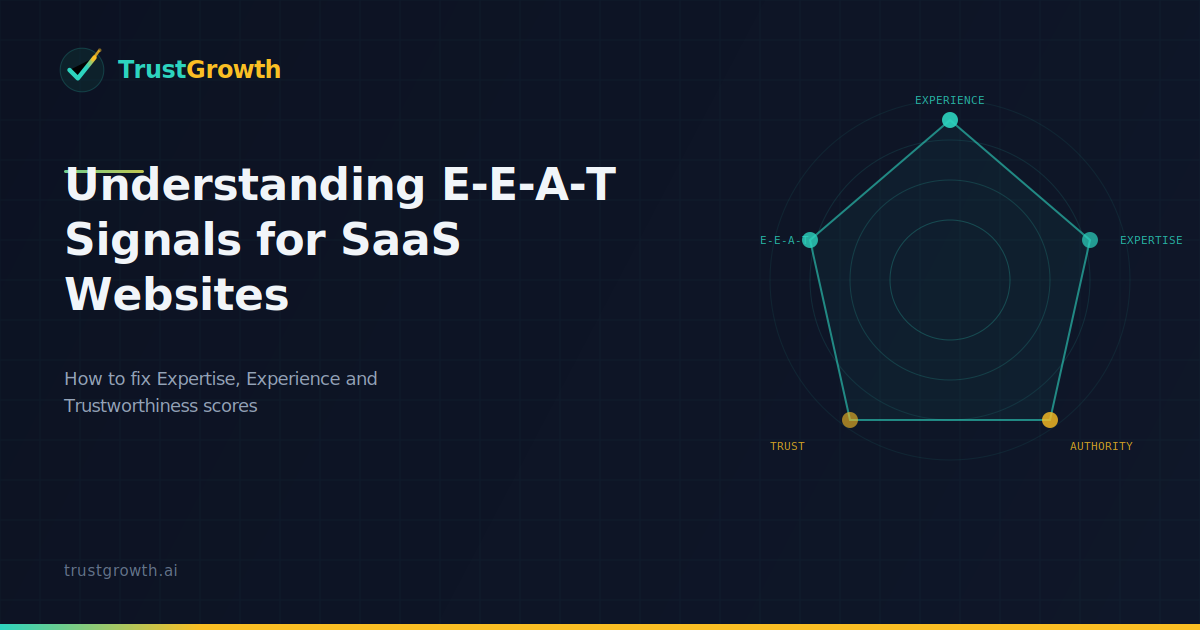
Most SaaS sites score well on Expertise but poorly on Experience and Trustworthiness. Here's how to fix that with actionable E-E-A-T improvements.
Article highlights
- Estimated reading time: 3 minutes
- Published on: March 25, 2026
- Last updated: March 29, 2026

Article
If you're running a SaaS product and wondering why your content isn't ranking, there's a good chance your site is missing key E-E-A-T signals. Google's quality raters look for Experience, Expertise, Authoritativeness, and Trustworthiness — and SaaS sites often fall short on all four.
What Is E-E-A-T?
E-E-A-T isn't a ranking factor per se — it's a framework Google's human quality raters use to evaluate content. But the signals that demonstrate E-E-A-T absolutely influence how Google's algorithms rank your pages.
Experience
Does your content show first-hand experience with the topic? For SaaS, this means:
- Case studies with real data from your product
- Screenshots and walkthroughs showing actual usage
- Lessons learned from building and scaling your product
Expertise
Is the author qualified to write about this topic? Signals include:
- Author bios with relevant credentials
- Technical depth that goes beyond surface-level advice
- Original research or data from your platform
Authoritativeness
Is your site recognized as a go-to resource? Build authority through:
- Backlinks from respected industry publications
- Mentions in podcasts, conferences, and newsletters
- A consistent publishing cadence on your core topics
Trustworthiness
Can users trust your site? The basics matter:
- HTTPS everywhere
- Clear privacy policy and terms of service
- Accurate contact information
- Transparent pricing (no hidden fees)
How TrustGrowth Measures E-E-A-T
TrustGrowth's audit pipeline checks 40+ signals across all four E-E-A-T dimensions. Each signal is scored individually, then rolled up into dimension scores and an overall trust score.
The key insight: most SaaS sites score well on Expertise but poorly on Experience and Trustworthiness. That's because founders focus on writing smart content but forget the structural signals that build trust.
Quick Wins
- Add author bios to every blog post with real photos and credentials
- Link to your about page from the footer — make it easy to find
- Add structured data (Organization, Article, FAQ schemas)
- Show social proof — testimonials, logos, case study links
- Publish consistently — a content calendar beats sporadic posting
What's Next
Run a free audit on TrustGrowth to see your E-E-A-T breakdown. The report shows exactly which signals you're missing and prioritizes fixes by impact.
FAQ
What does E-E-A-T stand for?
E-E-A-T stands for Experience, Expertise, Authoritativeness, and Trustworthiness. It's a framework Google's quality raters use to evaluate web content and websites.
Is E-E-A-T a direct ranking factor?
No, E-E-A-T is not a direct ranking factor in Google's algorithm. However, the signals that demonstrate E-E-A-T — like author credentials, backlinks, and trust indicators — do influence rankings.
How can I improve my site's E-E-A-T?
Start with quick wins: add author bios to all content, link your about page from the footer, implement structured data (Organization, Article schemas), show social proof like testimonials, and publish content consistently.
Why do SaaS sites struggle with E-E-A-T?
Most SaaS sites score well on Expertise because founders write smart technical content, but they often miss Experience signals (case studies, real data) and Trustworthiness basics (clear policies, contact info, transparent pricing).
Know your site's real SEO score
Free GSC-verified audit, E-E-A-T scoring, and AI-powered content strategy.
Get Started Free