Why Authority Belongs in the TrustGrowth Score
Why authority belongs in the TrustGrowth score: what authority measures, what it excludes, and how to inspect the evidence.
Article highlights
- Estimated reading time: 7 minutes
- Published on: July 24, 2026
- Last updated: July 28, 2026
Article
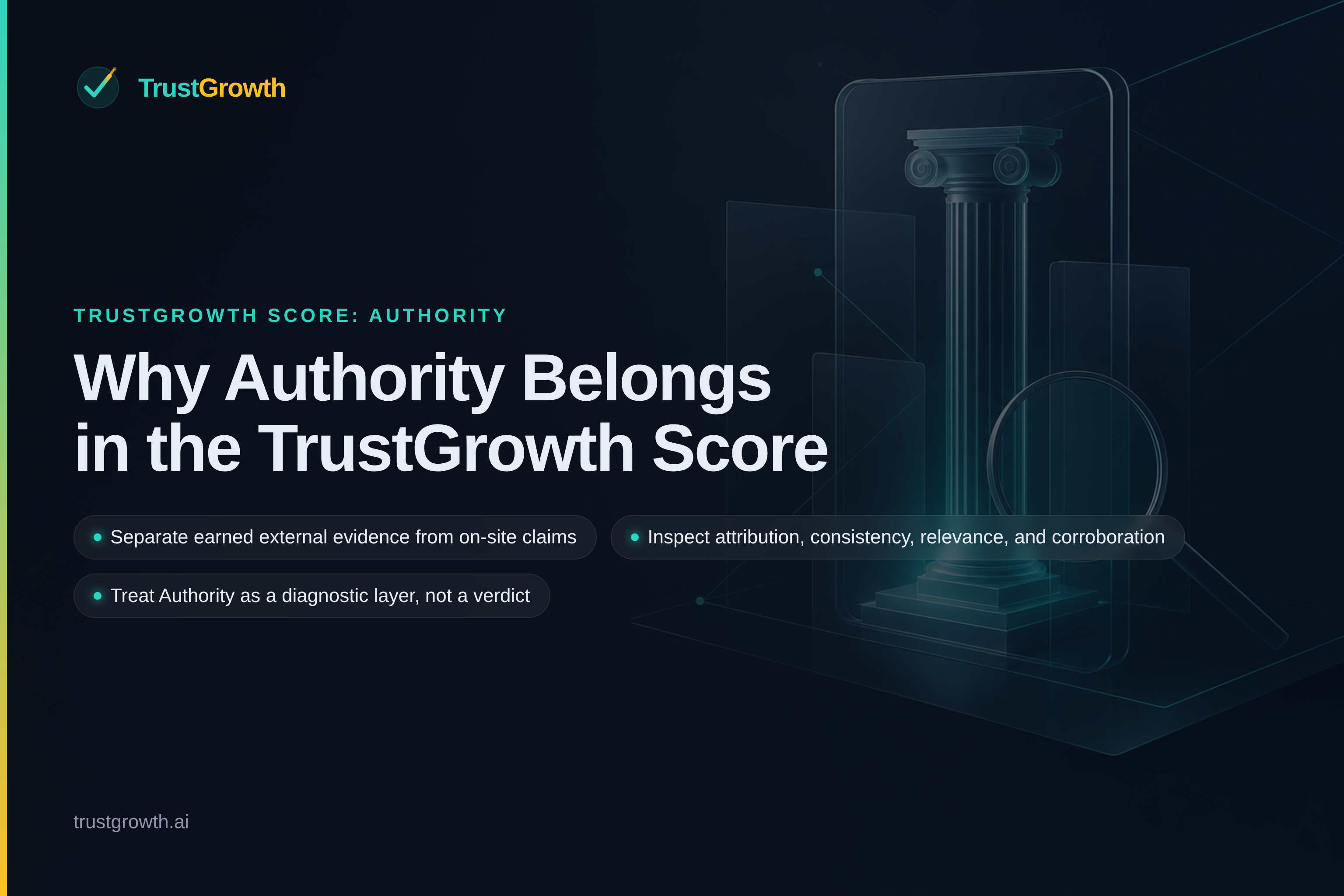
Why Authority Belongs in the TrustGrowth Score
A site can look strong on-page and still lack inspectable outside recognition.
That is the core reason behind why authority belongs in the TrustGrowth score. You can publish polished content, clean up technical issues, and organize your pages well, yet still leave a reviewer with one unresolved question: what evidence exists beyond your own site that supports your claims?
This article stays narrow on purpose. It explains what authority means in this score, why it deserves its own diagnostic layer, what stronger authority looks like directionally, and what this pillar does not claim to measure.
No secret formula is being revealed here. No vanity-number chasing is being encouraged. No ranking, traffic, or conversion outcome is being promised. The point is simpler: authority is a diagnostic dimension tied to earned, inspectable reputation signals, not a black-box authority number.
Why authority belongs in the TrustGrowth score
Authority belongs in the TrustGrowth Score because a site can be technically sound and content-rich while still lacking inspectable evidence of earned reputation. This pillar measures whether external, attributable proof exists that supports the site's expertise and claims, rather than relying on self-description or vanity metrics alone.
That distinction matters in an audit model built around evidence you can inspect. A site-health review checks crawlability, rendering, and index readiness. A performance review checks whether the user experience holds up. A content review checks whether there is substantive material to evaluate. Authority answers a separate question: does the site show earned recognition beyond its own pages?
That is why authority is not interchangeable with the other score dimensions documented in Site Health Score Explained, Why Performance Belongs in the TrustGrowth Score, and Why Growth Belongs in the TrustGrowth Score. Those layers evaluate different evidence types. Authority exists because external corroboration is a real audit category, not a side note.
What authority measures, and what it does not
Authority here means externally evidenced reputation and recognition that a reviewer can inspect. That includes citations, attributable mentions, consistent entity details, public references, and other earned signals that point outside the site itself.
The key terms are inspectable and earned. If a claim has no corroboration path, it is weaker as evidence. If a mention exists but has no attribution, context, or relevance, it is also weaker as evidence. The methodology focus is not on collecting a large pile of disconnected references. It is on whether a reviewer can trace a claim to supporting proof.
What this is not
This article is not a rewrite of broader E-E-A-T explainers. It covers a narrower diagnostic layer.
Authority in this score is not:
- the same thing as technical health
- the same thing as content quality
- identical to E-E-A-T as a whole
- equivalent to third-party authority metrics
- a universal truth about reputation
That distinction is important because flattening everything into one reputation number hides the evidence quality. TrustGrowth's published methodology emphasizes inspectable outputs, source context, and explicit handling of uncertainty.
The narrow definition used here
For this pillar, authority means signals such as:
- Independent mentions or citations
- Author or organization references on third-party sites
- Evidence-backed authorship and identity consistency
- Public proof that supports expertise claims
- Contextual recognition in relevant topical spaces
Each signal suggests one limited thing: there is external evidence a reviewer can inspect. It does not declare that authority has been fully established. It does not erase the need for human judgment. For that boundary, read what you can quantify vs. what still requires human judgment.
Why this diagnostic layer matters
A site can pass many on-site checks and still provide little off-site corroboration. That is the gap this pillar is designed to surface.
If your review stops at on-page quality, you can over-credit a site that looks complete but leaves reputation claims unsupported. An about page can say "expert," "trusted," or "leading" without giving a reader any clear path to verify those labels. An author bio can make experience claims without any attributable references elsewhere. A company page can list capabilities without public proof.
In an evidence-first model, that gap should be visible. The score should point you toward proof, not ask you to trust the score blindly. That is also why authority evidence should not be flattened into the same category as technical warnings or content gaps. Different evidence types answer different review questions.
Authority answers a different question than other pillars
The cleanest way to understand this pillar is to compare the questions each dimension asks.
| Score dimension | Main question | Evidence type |
|---|---|---|
| Site health | Can the site be crawled, rendered, and understood? | Technical states, page signals, structural readiness |
| Performance | Does the experience hold up when pages load and interact? | User-experience and delivery signals |
| Content | Is there substantive, useful material to evaluate? | On-page depth, clarity, and coverage |
| Authority | Is there inspectable evidence of earned recognition? | External citations, attribution, corroboration |
| Growth | Is there verified search-performance context? | Search visibility and change data |
This article focuses only on the fourth row. It does not restate the broader E-E-A-T framework, and it does not claim that authority alone is enough.
What stronger authority looks like directionally
Authority is easier to verify when claims have attributable sources, matching entity details, and topic-relevant third-party references.
That means stronger patterns usually look like corroboration, consistency, and relevance. A reviewer can follow the trail from an on-site claim to supporting evidence elsewhere. Named people and organizations are attributable. References align with the site's actual topic focus. Public proof is current enough to remain meaningful in context.
Signals this pillar is trying to capture
The following categories are directional indicators, not a complete checklist:
- Independent mentions or citations: These suggest that someone outside the site has referenced the entity, author, or material.
- Author or company references: These suggest that claims of expertise or experience have a visible identity trail.
- Identity consistency: Matching author names, organization details, and about-page information make inspection easier.
- Public proof pages or references: These support claims with attributable documentation rather than marketing language.
- Topical recognition: Mentions from relevant contexts are stronger than disconnected references.
Why inspectability matters more than counts
A long list of mentions without context is weak evidence. Source context, attribution, and topical fit matter more than raw totals.
A badge, logo strip, or generic "featured in" section can be hard to evaluate if it lacks traceable references. A mention with no named author, no linked source, or no topical connection is also hard to evaluate. Inspectable context matters more than abstract volume.
Examples of healthier authority patterns
These examples show what stronger evidence looks like without turning it into a threshold list:
- An author page aligns with cited work or profiles elsewhere.
- A company claim is backed by a public reference that a reader can inspect.
- A topical mention appears in a relevant publication, documentation page, or community context.
- Entity details stay consistent across the site and third-party references.
These patterns are stronger than isolated self-published claims because they create a corroboration path. The value is not the existence of a badge. The value is the inspectable trail behind the claim.
What this pillar does not measure perfectly
This pillar is intentionally limited.
It does not:
- fully capture offline reputation
- settle whether every mention is high quality
- replace expert human review
- convert reputation into an objective universal fact
Authority is inherently partial when measured from available web evidence. That limitation follows from the methodology's focus on inspectability and explicit uncertainty.
How to read this pillar in an evidence-first model
You should read authority as a diagnostic layer, not a verdict.
A stronger result points to evidence worth inspecting manually. A weaker result points to missing corroboration, inconsistent entities, or thin public proof. In both cases, the right next step is the same: inspect the underlying references rather than trusting a headline number.
This is where the score model stays claim-safe. It does not claim certainty where evidence is partial — the published methodology is explicit about that limit, and points you to the underlying references to review. For the broader proof framework, see what TrustGrowth publishes and how to inspect it.
What this means for your site
Start by reviewing your highest-stakes claims as if you do not already believe them. Check whether each claim has an attributable, public corroboration path outside your own pages. Then check whether your author, brand, and organization details stay consistent wherever that evidence appears.
If the trail is thin, vague, or hard to verify, that is the practical takeaway: your authority layer is harder to inspect than your on-page materials suggest. That is exactly why authority belongs in an evidence-first score.
Claim-safety checklist
- No named competitors or vendors appear in this article.
- No formulas, thresholds, weights, or internal scoring logic are disclosed.
- No ranking, traffic, conversion, or business outcome claims are made.
- All methodology references point to live
trustgrowth.aiURLs. - The article uses current-state framing only.
- Authority is presented as a partial, inspectable diagnostic layer, not a verdict.
Know your site's real SEO score
Free GSC-verified audit, E-E-A-T scoring, and AI-powered content strategy.
Get Started Free