AI SEO Explained: Where Automation Helps and Where Human Judgment Still Matters
Learn where AI SEO automation helps with audits, content, and monitoring—and where founders still need human judgment, verification, and first-party evidence.
Article highlights
- Estimated reading time: 10 minutes
- Published on: October 23, 2026
- Last updated: October 23, 2026
Article
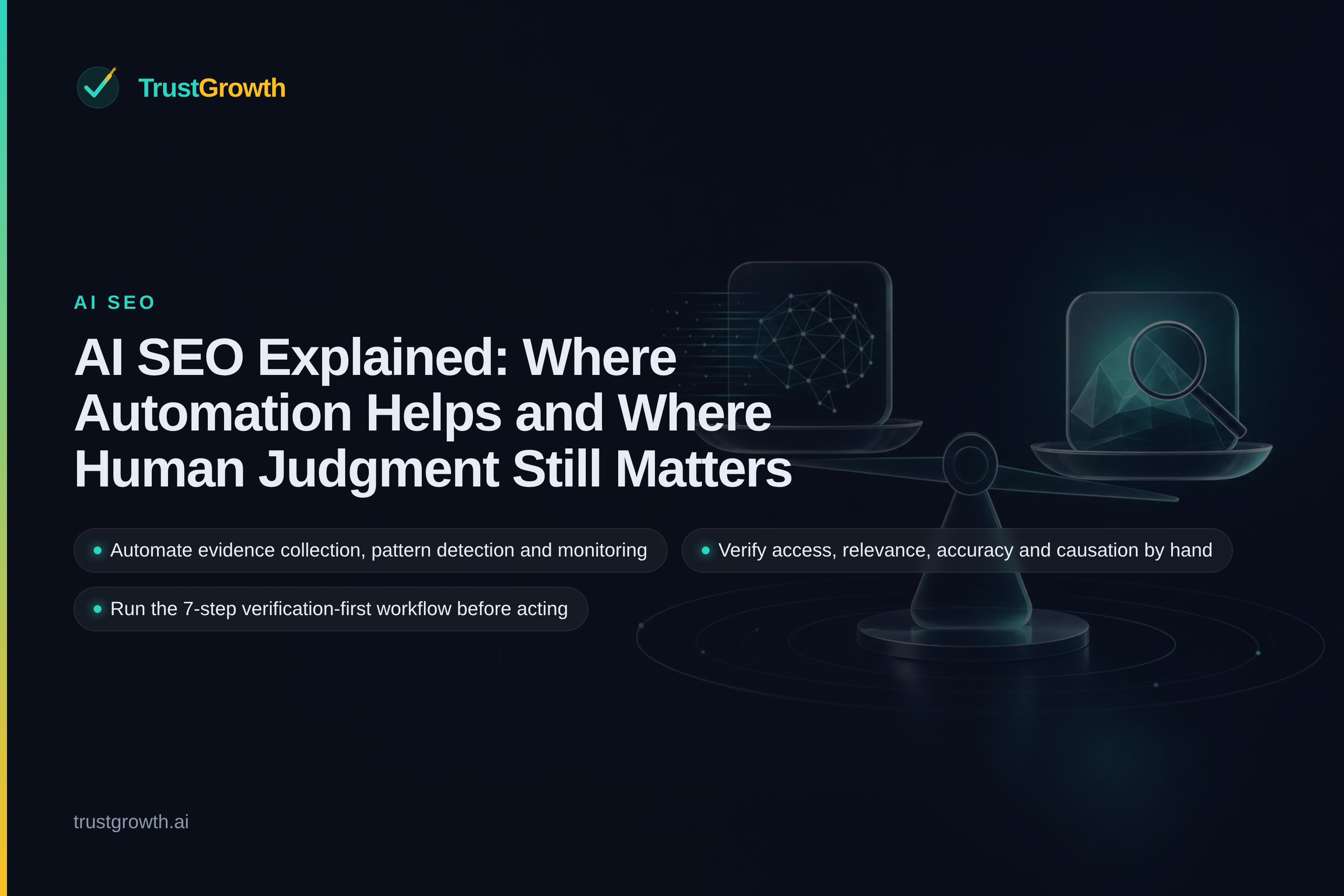
AI SEO Explained: Where Automation Helps and Where Human Judgment Still Matters
What we measured
- Method: This article defines an evidence-first workflow rather than reporting a new site test.
- Sample: No original crawl, Search Console export, ranking study, or prompt panel was used.
- Date range: Not applicable.
- Headline finding: AI can accelerate SEO work, but it cannot independently prove that a recommendation is correct, useful, or commercially relevant.
If you cannot tell whether Google or an AI system can actually see your site, more automation will not solve the underlying problem. AI SEO can reduce the time required to collect evidence, find technical defects, cluster queries, draft alternatives, and monitor visibility. It cannot independently establish whether the data is complete, the recommendation is correct, the content is valuable, or the change caused an outcome.
That distinction matters for indie and technical founders. You usually need a faster way to understand your site, not a polished score with unknown inputs. This guide explains what to automate, what to verify manually, and how to test an AI SEO tool before trusting it.
What is AI SEO?
AI SEO is the use of artificial intelligence across SEO research, auditing, content production, optimization, and measurement. An AI SEO tool may crawl URLs, analyze Google Search Console data, cluster queries, draft content, suggest links, or summarize changes. The output is useful only when its inputs, definitions, coverage, and limitations are visible.
Classic SEO automation executes repeatable rules, such as checking status codes or finding missing title tags. AI-assisted SEO adds language analysis, classification, summarization, and generation. Optimization for AI search is different: it aims to help systems such as ChatGPT, Google AI experiences, or Perplexity access, understand, retrieve, cite, or mention your pages.
Rankings, clicks, AI citations, brand mentions, and conversions are related but non-identical outcomes. A page can rank without being cited by an answer engine. A brand can be mentioned without receiving a click. A tool score proves none of these outcomes unless the measurement method is defined.
What does AI SEO include?
AI SEO is not one standardized discipline or score. Semrush, Ahrefs, Screaming Frog, Google Search Console, ChatGPT, and site-audit platforms can measure different things, including crawlability, rankings, query demand, citations, mentions, or content patterns.
The cleanest way to evaluate an AI workflow is to separate three layers:
- Inputs: URL inventories, HTML, status codes, robots.txt, structured data, Search Console queries, analytics, logs, or a defined prompt set.
- Transformations: crawling, extraction, clustering, classification, summarization, comparison, or generation.
- Outputs: defects, content briefs, recommendations, scores, work items, reports, or monitoring alerts.
An AI system can process supplied data. It cannot compensate for missing access, stale data, an incorrectly scoped Google Search Console property, or an undefined query set. Ask for the source URL, timestamp, crawl coverage, sample size, and failed or unknown states for every material finding. See what Google Search Console query data can and cannot prove before treating query movement as business evidence.
AI-assisted SEO and SEO for AI search are different
AI-assisted SEO means using AI to accelerate conventional SEO work. AI-search optimization, often called GEO or answer-engine optimization, means improving the probability that an AI system can access, understand, retrieve, cite, or mention your site.
These activities overlap but require different tests. A crawl can show that a page returns HTTP 200. It cannot show that ChatGPT retrieved that page for a particular answer. A Search Console impression can show visibility in Google Search. It cannot show that an AI system will cite the page.
Use the measurement target to choose the label. For retrieval and citation work, define the model, prompt set, date, reruns, and source attribution. For SEO work, define the Search Console property, URL scope, query set, date range, and intended business outcome. An AI mention and a citable, retrievable source are different kinds of evidence. Keep them in separate columns before you combine metrics.
Where AI SEO automation helps
1. Finding and organizing evidence
Automation is strongest when the task is broad, repetitive, and observable. Screaming Frog, Sitebulb, Google Search Console, and log-analysis tools can help collect URL inventories, status codes, indexability signals, Core Web Vitals inputs, structured data, headings, titles, internal links, and query data.
Require provenance for each result. A useful finding identifies the source URL, timestamp, crawl coverage, affected URLs, and data definition. “Your site has technical issues” is not a reproducible finding; “these URLs returned a redirect during this crawl” is.
2. Detecting repeatable technical patterns
AI and rule-based crawlers can detect broken links, missing metadata, duplicate patterns, canonical inconsistencies, inaccessible resources, and obvious structured-data errors. They can group similar problems so you do not inspect every page manually.
A detected pattern is a finding to verify, not proof of ranking impact. Confirm the HTML, rendered page, response headers, robots.txt behavior, and Search Console status before assigning priority. If access is uncertain, use this method to tell whether an SEO tool actually measured your site.
3. Turning data into priorities
AI can cluster queries, map pages to intent, summarize recurring defects, and turn findings into work items. The recommendation becomes actionable when it includes affected URLs, evidence strength, estimated effort, expected outcome, and an owner.
Do not let an AI system silently decide that a low-volume page matters more than a product page. Your market, sales motion, margins, positioning, and customer language are business inputs that a URL alone cannot reveal.
4. Drafting and transforming content
ChatGPT, Claude, and other language models can produce outlines, title variants, alternative explanations, FAQ candidates, summaries, and format conversions. They are useful for reducing blank-page time and creating reviewable alternatives.
Human review must verify product claims, dates, statistics, comparisons, citations, technical instructions, and examples. Remove generic filler and unsupported certainty. Keep a reason for every generated section, then add first-party evidence or original analysis where it exists.
5. Monitoring and regression detection
Recurring checks can monitor access, indexation changes, performance regressions, query movement, AI crawler reachability, and samples of citations or mentions. Store the exact prompt, model or tool version, date, query set, comparison period, and URL scope.
A changed score is an alert, not an explanation. Recheck the underlying evidence before opening a large remediation project.
Where human judgment still matters
Can the tool reach and measure your site?
“Not found,” “not accessible,” “not indexed,” and “not measured” are different states. Check crawl coverage, robots.txt, authentication, JavaScript rendering, API permissions, Search Console property scope, and data freshness.
A polished score without provenance is not a reliable diagnosis. A read-only Google Search Console connection can provide first-party evidence, but it does not automatically prove that every URL was crawled or that an AI system retrieved a page.
Is the recommendation relevant to your business?
A tool cannot reliably infer your best customer, market category, sales motion, acceptable trade-offs, or product differentiation from a URL. Compare each recommendation with customer language, product capability, search intent, and current business priority.
For example, expanding a topic cluster may create more pages while making the site harder to maintain. The correct action may be consolidation, clearer positioning, or no change at all.
Is the content accurate and useful?
Accuracy requires checking claims against primary documentation, product interfaces, source dates, and your own records. Use AI to propose language, not to manufacture evidence.
Useful content answers a real question, explains limitations, and gives the reader enough context to act. It is not defined by word count or by the number of pages generated.
What does E-E-A-T require?
E-E-A-T refers to experience, expertise, authoritativeness, and trustworthiness. Automation can inspect observable signals such as author markup, author-page links, organization details, citations, and visible evidence. It cannot fully judge lived experience, source quality, expertise, or reader usefulness.
Never present an automated E-E-A-T score as Google’s score or as a complete judgment of trustworthiness. Read what E-E-A-T measurement can and cannot quantify.
Did the change cause the outcome?
Do not infer causation from a ranking change, traffic increase, or AI mention after one edit. Compare a defined baseline and date range while accounting for seasonality, query changes, competitor movement, algorithm updates, sampling variation, and delayed effects.
The defensible statement is usually narrower: “This page changed after the edit during this comparison period.” That observation does not prove the edit caused the change.
What is a verification-first AI SEO workflow?
Use this seven-step workflow when an AI system proposes a diagnosis or action:
- Define the outcome. Choose rankings, qualified clicks, indexation, citations, mentions, or conversions.
- Define the source and method. Specify Google Search Console, a crawl, CrUX, an analytics report, server logs, or a controlled prompt set.
- Capture the baseline. Record values, dates, sample size, URL scope, query set, and coverage.
- Request a diagnosis. Ask the AI system for evidence, uncertainty, and a proposed action—not an unreviewed verdict.
- Test the smallest useful scope. Change a limited set of pages or one technical condition.
- Re-run the same measurement. Use the same source, definitions, query or prompt set, and comparison method.
- Publish the limits. State what changed, what the test supports, and what it cannot prove.
Use this reproducibility template:
Tool and version:
URL scope:
Query or prompt set:
Date collected:
Baseline:
Observed result:
Evidence source:
Limitation:
Action taken:
Re-test result:
Every AI-generated SEO recommendation should pass this provenance test before it becomes work.
How should you evaluate an AI SEO tool?
Evaluate capability, not marketing language. Ask these questions:
- Does the tool use first-party data or estimates?
- Does it expose source URLs, timestamps, crawl coverage, query definitions, and unknown states?
- Does it separate detection, diagnosis, and recommendation?
- Do scores have definitions, uncertainty labels, and stable versioning?
- Can you export the inputs and reproduce the finding?
Run the same site through two tools, then compare methods before comparing percentages. A score of 72 in one system and 61 in another may reflect different URL scopes, rules, or data sources rather than a disagreement about your site.
Test each tool on three questions: what it automates, what evidence it exposes, and what it leaves for human review. The useful result is not a universal winner. It is a record of where each tool detects, explains, fails, or remains unknown.
What AI SEO is not
AI SEO is not a guarantee of rankings, traffic, citations, or sales. It is not a substitute for customer research, technical ownership, editing, or measurement design.
It is not permission to publish high-volume generic pages. A tool score is not evidence that a page was indexed, retrieved by an AI system, cited, or trusted. Treat every automated output as a hypothesis until you can inspect its source and re-run its measurement.
FAQ: questions founders ask about AI SEO
What is SEO for AI?
SEO for AI can mean using AI to perform SEO work or optimizing a site so AI systems can access, understand, retrieve, cite, or mention it. These are related but different activities, and neither guarantees visibility.
What is AI SEO called now?
There is no universally accepted replacement term. “AI SEO” commonly describes AI-assisted SEO, while GEO, AEO, and AI-search optimization may describe work aimed at generative or answer-engine visibility. Define the measurement target before choosing a label.
Can ChatGPT do SEO?
ChatGPT can organize research, cluster queries, draft content, analyze supplied data, and design tests. It cannot independently verify site access, establish business relevance, guarantee rankings, or replace technical and editorial review.
Is SEO still worth it in 2026?
SEO remains useful when it produces qualified discovery, accessible pages, and measurable business outcomes. Define the outcome and baseline instead of treating rankings, impressions, or AI mentions as sufficient proof.
What is replacing SEO?
No single channel has replaced SEO. AI-generated answers, social discovery, communities, referrals, and product-led distribution change discovery, but crawlability, useful content, evidence, and measurement still matter for search and AI retrieval.
Is SEO a high-income skill?
No reliable conclusion follows from the label alone. SEO value depends on diagnosing real problems, connecting work to business outcomes, communicating uncertainty, and verifying results—not on knowing a particular AI tool.
Summary: automate repetition, retain judgment
Automate collection, classification, repetition, monitoring, and first drafts. Retain human judgment for access validation, definitions, prioritization, truth, usefulness, E-E-A-T interpretation, causation, and trade-offs.
TrustGrowth is built by TechWright Labs and commercially provides read-only, Google Search Console-connected website audits, growth diagnostics, content strategies, and site-specific public proof pages. You can run a Google Search Console-verified website audit and inspect the resulting snapshot. The audit documents observed signals; it does not predict rankings or AI citations.
Limits of this analysis
- This article reports no original crawl, ranking study, Search Console export, or controlled AI prompt test.
- It cannot establish which tool is most accurate for your site.
- It cannot prove that an AI recommendation will improve rankings, traffic, citations, or conversions.
- AI crawler access, model behavior, search interfaces, and tool definitions can change after publication.
- A score without its source, date, scope, and method cannot be independently interpreted.
Know your site's real SEO score
Free GSC-verified audit, E-E-A-T scoring, and AI-powered content strategy.
Get Started Free