AI Visibility Overview: From Brand Mentions to Citable Evidence
Understand AI visibility through five measurable stages: Reach, Readable, Retrieved, Recalled, and Impact. Learn what mentions and citations actually prove.
Article highlights
- Estimated reading time: 9 minutes
- Published on: October 20, 2026
- Last updated: October 20, 2026
Article
AI Visibility Overview: From Brand Mentions to Citable Evidence
You may rank in Google, appear in Google Search Console, and still be absent from ChatGPT, Claude, Gemini, or Google AI Overviews. The problem is that “AI visibility” is often treated as one score when it describes several different events.
An AI visibility overview explains whether an AI system can reach your site, read its content, retrieve it as a source, recall your brand without prompting, and show any observable relationship with search outcomes. It is not one universal score. The result depends on the system, test method, prompt set, date, geography, and whether you measure access, citations, brand recall, or downstream impact.
What does an AI visibility overview actually measure?
AI visibility is the observable extent to which AI answer systems can fetch, interpret, retrieve, name, and cite a company or website. For an indie founder, that means separating what an answer engine can technically access from what it chooses to show in an answer.
AI visibility is not the same as Google rankings, Google Search Console impressions, organic traffic, brand awareness, or an AI detection score. A Google ranking measures a search result position; Search Console records Google-owned search data; brand awareness concerns recognition by people; and an AI detector estimates whether text resembles generated content.
Keep unknown separate from blocked and not visible. A blocked crawler has evidence of an access restriction. A not-visible result records an unsuccessful observation under a defined test. Unknown means the method did not establish the answer.
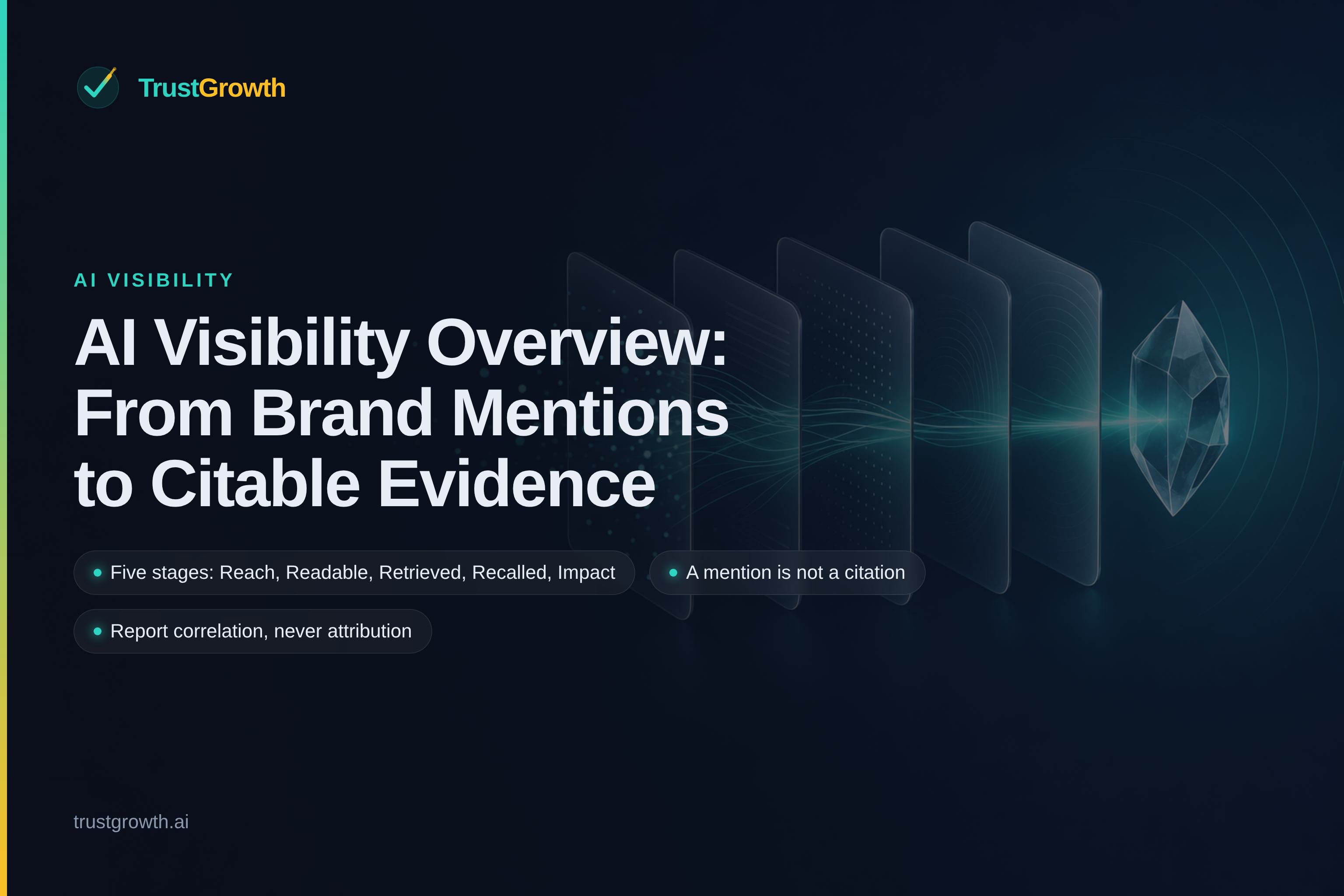
TrustGrowth uses five stages: Reach, Readable, Retrieved, Recalled, and Impact. These stages should not be collapsed into one headline percentage because a site can be reachable but not readable, readable but not retrieved, retrieved but not recalled, or recalled without measurable impact.
How TrustGrowth measures AI visibility
The five-stage method assigns a different question and measurement nature to each stage.
| Stage | Question | Measurement nature | What it proves | Limitation |
|---|---|---|---|---|
| Reach | Can AI crawlers fetch the site? | Count from a fixed crawler probe | The defined crawler could fetch the tested resource | It does not represent every crawler or prove citation |
| Readable | Can a machine read what was fetched? | Deterministic score | The content meets published machine-readability rules | It does not prove a model understands every page |
| Retrieved | Is the site cited as a source? | Census count | Qualifying citations were observed | A citation does not prove causation or recommendation |
| Recalled | Is the brand named unprompted? | Sampled result with confidence interval | Brand naming occurred under defined prompts and models | Wide uncertainty can make the result unusable |
| Impact | Did anything move alongside visibility? | Correlation with Google Search Console data | Two observations moved together under the method | Correlation is not attribution |
Reach and Readable
Reach tests whether the relevant crawler can fetch the site through a fixed probe. A robots.txt rule or server response provides evidence about access conditions, not proof that ChatGPT, Google Gemini, Anthropic Claude, or another system will cite or recommend the site. The result is a count from the defined probe, not a universal statement about every crawler.
You can use TrustGrowth’s free keyless Reach check without an account. It tests Reach only. For a procedure that focuses specifically on access verification, see how to verify whether AI crawlers can fetch a site.
Readable begins after fetching succeeds. The assessment considers response content, page structure, rendering, canonical signals, and whether the intended information can be extracted. Its deterministic score follows published rules; it is not a judgment that Claude, GPT, or Gemini understands every page.
Retrieved, Recalled, and Impact
Retrieved means the site is cited as a source. Treat it as a census count, not a sample-based mention rate. Check each citation for URL relevance, support for the associated claim, freshness, and source fidelity; a URL can appear without proving that the page caused the answer. This guide to checking AI citations explains that verification step.
Recalled means the brand is named without being supplied in the prompt. Test it across Claude, GPT, and Gemini, then report a confidence interval. Withhold the result when the interval is too wide to support a useful claim.
Impact is deliberately narrow: it asks whether an observable visibility measure moved alongside Google Search Console data. Report correlation only. Search Console can verify Google-owned search data and selected site conditions, but it cannot directly prove that an AI answer caused a ranking, click, or traffic change.
Why Google indexing does not settle AI visibility
Google indexing does not prove AI visibility because indexing, retrieval, recall, and citation are different events. A page can be indexed by Google yet absent from an AI answer, cited without being prominent, or mentioned without a relevant first-party citation.
Google Search Console is useful for Google search performance and site conditions. It cannot directly prove whether OpenAI, Google Gemini, Anthropic Claude, or another answer system fetched, recalled, or cited your page. For the boundary between query data and stronger conclusions, see what Google Search Console data can and cannot prove.
Mentions are not citations
A branded prompt gives the system the company name, such as “What does TrustGrowth do?” An unbranded prompt withholds the name, such as “Which tools help indie SaaS founders understand AI crawler access?” Unbranded prompts test whether the system names a company without being given the brand.
A mention can reflect model memory, prompt wording, or third-party context rather than current first-party evidence. A citation is stronger source evidence only when the cited URL is relevant, supports the associated claim, is sufficiently fresh, and faithfully represents the source. A mention rate is not market share, and a citation does not guarantee future visibility.
Recalled and Retrieved therefore remain separate TrustGrowth stages. Brand mentions as a diagnostic provides useful context, while branded versus unbranded prompts shows why the prompt type changes the interpretation.
How to run a reproducible AI visibility overview
Use the same inputs each time so your result can be compared with a later result.
- Define one product category, audience, geography, and date range.
- Separate branded and unbranded prompt sets. Use a consistent prompt list and record why each prompt is eligible.
- Record the model or product surface, exposed model or version, logged-in state, location, date, prompt text, answer text, cited URLs, and result status.
- Repeat prompts or runs where the method calls for sampling. Report variance rather than treating one answer as a fact.
- Classify observations by stage: crawler access for Reach, machine-readability output for Readable, source citations for Retrieved, unprompted naming for Recalled, and Google Search Console correlation for Impact.
- Publish the sample definition, date, prompt list, scoring rules, and uncertainty treatment with any sampled result.
Use this copyable prompt without presupposing that your brand belongs in the answer:
Which tools help [specific audience] solve [specific problem]? Compare [category] using evidence from current websites. Cite your sources.
The prompt must not include your company name if you are testing unprompted recall. A reader can independently test only Reach without an account through TrustGrowth’s free keyless crawler-access check; it does not measure Readable, Retrieved, Recalled, or Impact.
What belongs in a minimal scorecard?
A useful scorecard preserves each output’s measurement type:
- Reach output: count of successful fetches from the fixed crawler probe.
- Readable output: deterministic machine-readability score under published rules.
- Retrieved output: census count of qualifying citations.
- Recalled output: sampled unprompted brand mentions across Claude, GPT, and Gemini, with a confidence interval and no reported result when the interval is too wide.
- Impact output: correlation between the relevant visibility observation and Google Search Console data, never attribution.
These outputs are not interchangeable. Do not compare a sampled recall result directly with a census retrieval count, and do not treat either as a universal market-share metric.
A defensible report can say: “On [date], [method] found [result] under [defined sample and model conditions]; the result does not establish causation or future visibility.” For Recalled, include the confidence interval or explain why the result was withheld. Why AI visibility results need uncertainty explains why a single percentage can mislead.
What is a good AI visibility score?
There is no universal good AI visibility score. A useful result depends on the stage, measurement nature, prompt intent, category competition, date, model coverage, and uncertainty.
Establish a baseline with one defined method and track comparable results over time. Keep branded and unbranded observations separate because a brand supplied in the prompt tests a different condition from a brand named without prompting. A Reach count, a Retrieved census, and a Recalled confidence interval answer different questions.
Improve the underlying conditions rather than chasing a composite number:
- Maintain indexable pages, clear information architecture, stable URLs, working canonical signals, and accessible content.
- Make claims citable by stating who, what, when, where the evidence comes from, and which page supports the claim.
- Expose clear authorship and organization context where appropriate. Structured data and authorship trust provide context, but neither guarantees retrieval.
- Create focused pages that answer one category question directly instead of publishing broad, repetitive AI-written copy.
- Earn independent references and comparisons. Treat links and mentions as context, not proof by themselves.
- Re-run the same defined test after a documented change, recording what changed and when.
How TrustGrowth fits into an AI visibility overview
TrustGrowth is a measurement and diagnostic layer, not a guarantee of inclusion in ChatGPT, Google AI Overviews, Gemini, Claude, or another answer system. Read TrustGrowth’s five-stage AI visibility method for the definitions of Reach, Readable, Retrieved, Recalled, and Impact.
The evidence boundary matters. Google Search Console can verify Google-owned search data and site conditions, but it cannot directly prove every AI system’s retrieval or citation behavior. The only stage you can test without an account is Reach, using the free keyless check.
FAQ: AI visibility overview questions
How can I check my AI visibility?
Define the stage first, then use a fixed method, date, model or crawler scope, and recorded inputs. TrustGrowth’s Reach stage can be tested without an account through its free keyless crawler-access check; Retrieved, Recalled, and Impact require their respective published measurement definitions.
What does AI visibility mean?
AI visibility describes what an AI answer system can fetch, read, retrieve as a source, recall about a brand without prompting, and what observable movement correlates with search data. It is not the same as Google rankings, traffic, brand awareness, or an AI detection score.
What is a good AI visibility score?
There is no universal good score because the stages use different measurement types and depend on systems, prompts, dates, categories, and uncertainty. Establish a baseline and compare like with like.
How can you increase AI visibility?
Improve crawl access and machine readability, make claims easy to support with specific source pages, clarify authorship and organization context, and publish focused answers to real category questions. Re-test after a documented change without claiming causation from one movement.
How do you enable AI Overviews?
Site owners cannot switch on guaranteed inclusion in Google AI Overviews. Maintain crawlable, useful, well-supported content and monitor Google’s published systems and Search Console evidence; eligibility does not guarantee an AI Overview result.
Is 27 AI detection bad?
A score of 27 is not an AI visibility measurement. An AI detector score cannot establish whether an answer engine can fetch, read, cite, or recall a site unless its method explicitly measures that behavior.
What is the best AI optimization tool for visibility?
Do not choose by headline score alone. Compare crawler scope, census or sampling design, model coverage, uncertainty reporting, source verification, reproducibility, and whether the tool separates Reach, Readable, Retrieved, Recalled, and Impact.
Limits of this analysis
This AI visibility overview cannot show whether a future answer will cite your page, whether a citation caused a click or ranking change, or whether one model’s behavior represents every answer engine. It also cannot convert a mention into market share or make a wide confidence interval precise. Those questions require a defined test, recorded inputs, and repeated observations.
Conclusion: report evidence, not just presence
Reach, Readable, Retrieved, Recalled, and Impact answer different questions. A mention is an observation; a citation is stronger source evidence; and a reproducible method makes either result interpretable.
Do not report one percentage when your evidence covers different systems and measurement types. Define the stage, record the method, preserve uncertainty, and compare the same test over time. Read the AI visibility method, or run the free keyless Reach check.
Know your site's real SEO score
Free GSC-verified audit, E-E-A-T scoring, and AI-powered content strategy.
Get Started Free