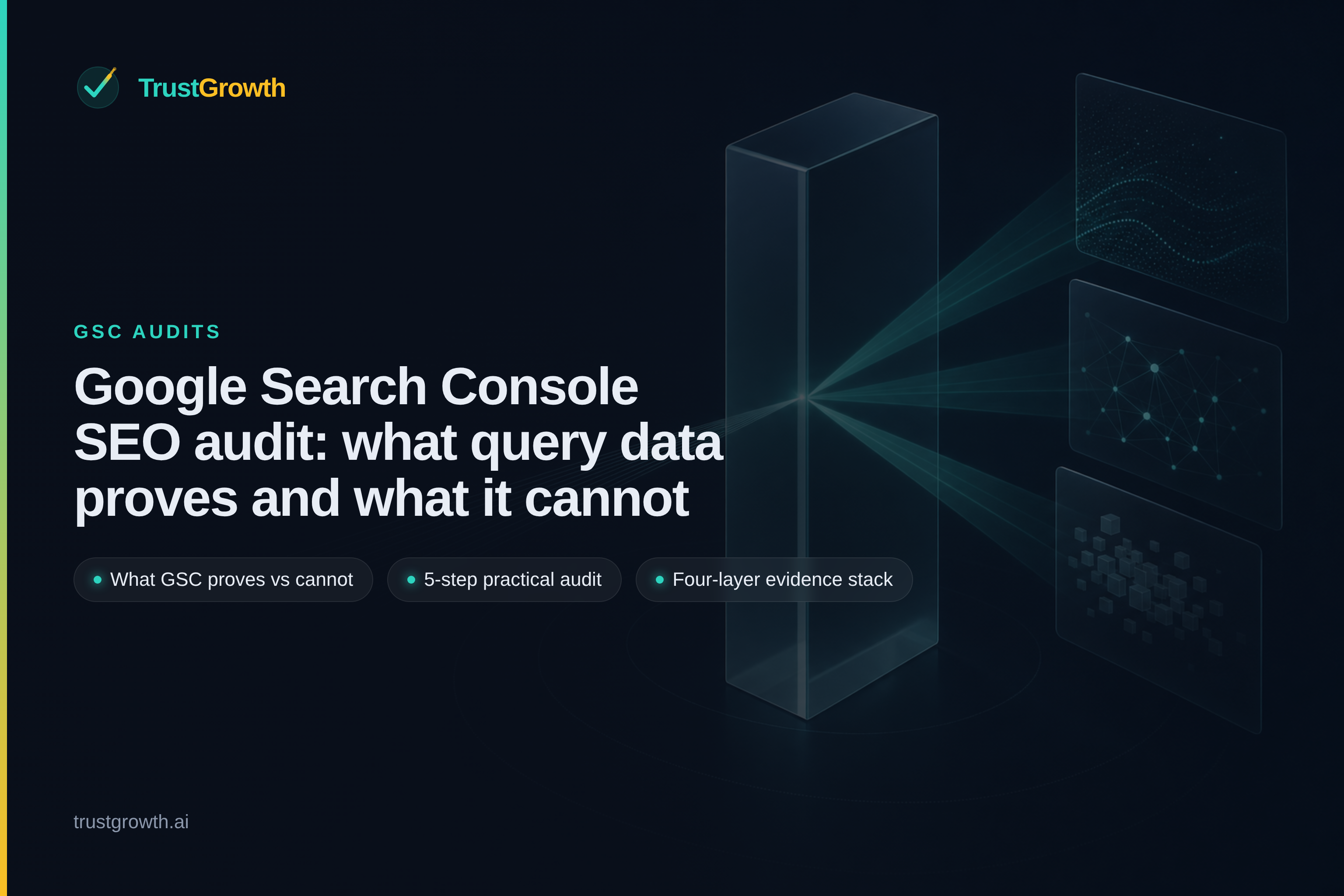
Google Search Console SEO audit: what query data proves and what it cannot
Run a Google Search Console SEO audit with first-party visibility evidence and separate rankings from trust, conversions, and AI retrieval.
Article highlights
- Estimated reading time: 10 minutes
- Published on: September 23, 2026
- Last updated: September 23, 2026
Article
Google Search Console SEO audit: what query data proves and what it cannot
The short answer
A Google Search Console (GSC) SEO audit can establish Google-reported visibility and selected technical states. It cannot establish causation, conversions, E-E-A-T (Experience, Expertise, Authoritativeness, Trustworthiness), or AI retrieval. This article is a documentation-based procedure; no site dataset was measured for it.
If you are an indie or technical founder deciding whether a traffic problem is real, start with GSC. Then add technical crawling, content review, analytics, and controlled checks in systems such as ChatGPT, Perplexity, Claude, Gemini, Microsoft Copilot, and Google AI Overviews.
What a Google Search Console SEO audit can prove
A Google Search Console SEO audit can prove what Google reported for a verified property during a defined date range. It is first-party evidence, unlike an Ahrefs, Semrush, or Moz estimate that may rely on sampled keywords or external crawls. Do not treat any third-party score as equivalent to Google-owned evidence.
The Performance report records:
- Queries and pages that received recorded impressions and clicks.
- Click-through rate (CTR) and average position.
- Country, device, search appearance, and date dimensions.
- Trends across a selected period and an equal-length comparison period.
Google documents these fields in its Search Console Performance report documentation. Record the property, date range, country, device, search type, and exported row count. Without those parameters, another person cannot reproduce the finding.
URL Inspection provides URL-level evidence: index status, Google-selected canonical, crawl information, and detected enhancements. The URL Inspection documentation makes the scope clear: inspecting 1 URL does not prove that every page using the same template behaves identically.
The Page indexing report groups known URLs into indexed, excluded, error, and validation-related states. Core Web Vitals reports field-experience groups for eligible URL groups, while the HTTPS report reports HTTPS issues and the Security Issues report reports problems such as hacked content or malware. Consult Google’s Page indexing documentation, Core Web Vitals documentation, HTTPS report documentation, and Security Issues report documentation.
GSC report Evidence it provides Useful decision Important limitation Performance Queries, pages, clicks, impressions, CTR, average position Prioritize visibility and snippet hypotheses Does not prove conversions or causation URL Inspection Index status, canonical, crawl details, enhancements Investigate a priority URL One URL is not a site-wide test Page indexing Indexed, excluded, error, and validation states Find recurring indexing patterns Categories require technical verification Core Web Vitals Field data grouped by URL type Prioritize real-user performance work Not a complete performance audit HTTPS and Security Issues Reported HTTPS or security problems Escalate confirmed risks A clean report does not prove total site healthTable 1. Capability summary based on the linked Google Search Central and Search Console documentation; no site dataset was measured.
For a longer workflow, use the full GSC audit playbook.
What query data cannot prove
A query row proves that Google recorded an impression or click for a property; it does not prove why the page appeared, whether the searcher was satisfied, or whether the business earned revenue. Impressions are appearances, not visits. CTR is a visibility ratio, not a measure of purchase intent.
Average position is an aggregate across impressions, queries, locations, devices, and time. A reported position of 8 is not a fixed eighth-place ranking for every searcher; verify the query, country, device, and date segments before changing a page based on that number.
Zero clicks can result from low position, low demand, search-result features, or reporting thresholds. Inspect the relevant search results page and compare the query, page, country, device, and date segments before deciding that a title or page is defective.
GSC cannot independently establish:
- Whether an author has genuine first-hand experience or whether content is accurate, original, useful, or persuasive.
- E-E-A-T, brand reputation, unlinked mentions, citation quality, or complete backlink quality.
- Whether ChatGPT, Perplexity, Claude, Gemini, Microsoft Copilot, or Google AI Overviews retrieved or cited a page.
- Whether a visitor subscribed, activated a product, generated a lead, or produced revenue.
- Competitor visibility outside your property, complete crawl behavior, or every rendering problem.
Google’s helpful content guidance discusses people-first content, but GSC does not publish a site E-E-A-T rating. Any third-party score is an inference. Read what an E-E-A-T score can and cannot measure for that distinction.
Claim Evidence available Not proven “This page has search visibility.” Recorded impressions for a defined period Total market demand or commercial intent “The page ranks eighth.” Aggregate average position of 8 A fixed position in every search “The title needs rewriting.” High impressions and low CTR in a segment That the title alone caused the CTR “The site is trustworthy.” No direct GSC trust score E-E-A-T, reputation, or experience “ChatGPT knows the brand.” Google Search visibility data AI retrieval, citation, or answer presenceHow to run a practical Google Search Console SEO audit
A useful Google Search Console SEO audit turns each observation into a testable next action. Follow these five steps.
1. Set the audit parameters first
Record the property, audit date, date range, timezone, country, device, search type, and export row limit. Compare equal-length periods, such as the last 90 days with the preceding 90 days; do not call a one-day change a trend.
Record the number of query, page, country, and device rows reviewed. Label the audit as measured, inferred, unknown, or manually reviewed.
2. Verify property coverage and timing
Check whether the property is domain-level or URL-prefix. Google’s property documentation explains that domain properties can include protocols, subdomains, and URL variants, while URL-prefix properties cover the specified prefix.
Confirm production HTTP and HTTPS URLs, www and non-www variants, subdomains, and migrations. GSC is delayed and directional, not a real-time analytics stream, so record the final available data date before exporting.
3. Find ranking and CTR opportunities
Export pages and queries, then segment them into four groups:
- High impressions with low CTR.
- Aggregate positions roughly 4–20 with meaningful impressions.
- Pages losing clicks or impressions against the comparison period.
- Queries where page intent, title, and description do not align.
Inspect the actual search results page before rewriting a title. Check ads, featured snippets, image results, local results, sitelinks, and intent. An opportunity remains a hypothesis until you implement a change and recheck a comparable period.
4. Check indexing and priority URLs
Review Page indexing for repeated exclusion patterns, then use URL Inspection on priority pages. Check index status, redirects, noindex, canonical selection, crawl information, and enhancements.
Connect each finding to a validation method. After removing an unintended noindex, request validation where appropriate and recheck the URL after Google processes the change. For a canonical mismatch, inspect rendered HTML and internal links before changing the canonical.
5. Review experience, enhancements, and security
Check Core Web Vitals, HTTPS, Security Issues, structured-data enhancement reports, PageSpeed Insights, and direct browser behavior. Use PageSpeed Insights and direct testing for mobile checks covered by this procedure.
Separate confirmed errors, warnings, sampled field data, and issues requiring manual review. A Core Web Vitals pass does not prove that redirects, JavaScript rendering, architecture, content, and security are healthy.
Why GSC query data needs a four-layer evidence stack
Each audit layer answers a different question, so you should not collapse all results into one unexplained score.
Layer Tools and evidence Question answered Search visibility GSC Performance and Page indexing What did Google report? Technical reachability Screaming Frog SEO Spider, Sitebulb, rendered HTML, redirects,robots.txt, canonicals, architecture
Can crawlers and users reach the intended content?
Trust and content evidence
Author identity, sources, first-hand proof, claims, product evidence, editorial ownership
Why should a reader trust and use this page?
Business and AI visibility
Google Analytics 4, conversion events, user research, ChatGPT, Perplexity, Gemini, Microsoft Copilot tests
Does visibility create outcomes, and can AI systems retrieve the site?
TrustGrowth is an optional next step, not a replacement for Google’s reports. Its GSC-connected audit combines 80+ technical, performance, and content checks with 27 inferred E-E-A-T signals. Those signals are TrustGrowth’s analysis, not Google’s private E-E-A-T rating; review the GSC-verified audits and scoring before interpreting a result.
What should you record in the audit worksheet?
A five-column worksheet makes every conclusion traceable. Publish a timestamped evidence trail for important changes instead of presenting an unexplained score.
Finding Source Date/sample What it proves Next test High impressions and low CTR GSC Performance Recorded date range; page/query segment Google recorded visibility and clicks in that segment Inspect the SERP and test title alignment URL Inspection shows indexed GSC URL Inspection Inspection date; 1 URL Google reports that URL as indexed Check canonical, rendering, and query coverage Author page lacks visible credentials Manual review Review date; 1 author page A visible authorship signal is absent Add verifiable identity and experience evidence Core Web Vitals passes GSC Core Web Vitals Report date; eligible URL group The reported field group passes Test representative templates on mobileMark every row as measured, inferred, unknown, or manually reviewed. This preserves current-state truth: what is true now, what is an interpretation, and what still needs a test.
Which GSC conclusions are commonly wrong?
- “Average position 8 means the page always ranks eighth.” Correction: it is aggregated. Verify query, country, device, and date filters.
- “Impressions prove demand converted into interest.” Correction: compare impressions with clicks, Google Analytics 4 sessions, and conversion events.
- “Indexed means competitive.” Correction: indexing is eligibility. Compare intent, content quality, links, and competitors.
- “A Core Web Vitals pass means the site is technically healthy.” Correction: crawl redirects, rendered HTML, architecture, HTTPS, and security separately.
- “GSC query data tells us what ChatGPT knows.” Correction: run dated retrieval and citation tests in each target AI system.
- “A third-party SEO score equals Google evidence.” Correction: inspect access, sample, date, and methodology. This is why estimated SEO scores can mislead.
FAQ about Google Search Console SEO audits
Is Google Search Console good for SEO?
Google Search Console is the free first-party source for Google visibility and indexing data; combine it with other tools for crawl, performance, content, and conversion checks.
Can ChatGPT do an SEO audit?
ChatGPT can analyze GSC exports and organize hypotheses, but it cannot independently verify complete property coverage, crawl behavior, conversions, or E-E-A-T. Validate its recommendations with GSC, a crawler, analytics, and manual review.
How do you do an SEO audit?
Define the property and date range, export GSC Performance data, review indexing and priority URLs, crawl the site, inspect content and trust evidence, compare analytics outcomes, and retest implemented fixes.
How do you check an SEO audit?
Check an SEO audit by tracing every claim to a source, date, sample, and verification step. Label each result measured, inferred, unknown, or manually reviewed.
How much does an SEO audit cost?
SEO audit cost depends on page count, software, technical scope, content depth, conversion analysis, and manual review time. State those inputs instead of claiming one universal price.
Where can I find a free SEO audit report?
Create a free evidence report from Google Search Console, Google Analytics 4, PageSpeed Insights, a crawler’s available free limits, and manual review. TrustGrowth also publishes public proof pages for audited sites.
Which tool is commonly used for SEO audits?
Google Search Console is commonly used for Google visibility and indexing, Screaming Frog SEO Spider and Sitebulb for crawling, Ahrefs and Semrush for backlink estimates, and Google Analytics 4 for outcomes.
What is the best free SEO checker?
Google Search Console is the best free starting point for first-party Google visibility and indexing data. Combine it with PageSpeed Insights, Google Analytics 4, a crawler, and manual content review.
Which SEO checker is the best?
The best SEO checker depends on the decision: GSC for Google visibility, Screaming Frog for crawl structure, Google Analytics 4 for outcomes, and manual review for trust and content quality. No single checker proves every SEO claim.
Use GSC as the starting evidence, not the complete verdict
A Google Search Console SEO audit shows what Google reported about visibility and selected technical states. It cannot by itself explain trust, content quality, conversions, backlink quality, or how ChatGPT, Perplexity, Claude, Gemini, Microsoft Copilot, or Google AI Overviews interpret your brand.
Next week, export the data, document parameters and row counts, isolate visibility hypotheses, inspect priority URLs, test fixes, and re-audit with technical, content, business, and AI evidence. If you want a structured starting point, run a TrustGrowth audit and inspect its public proof context before treating any inferred score as a verdict.
Method note: This procedure is based on the linked Google documentation. No site dataset was measured for this article.
Know your site's real SEO score
Free GSC-verified audit, E-E-A-T scoring, and AI-powered content strategy.
Get Started Free