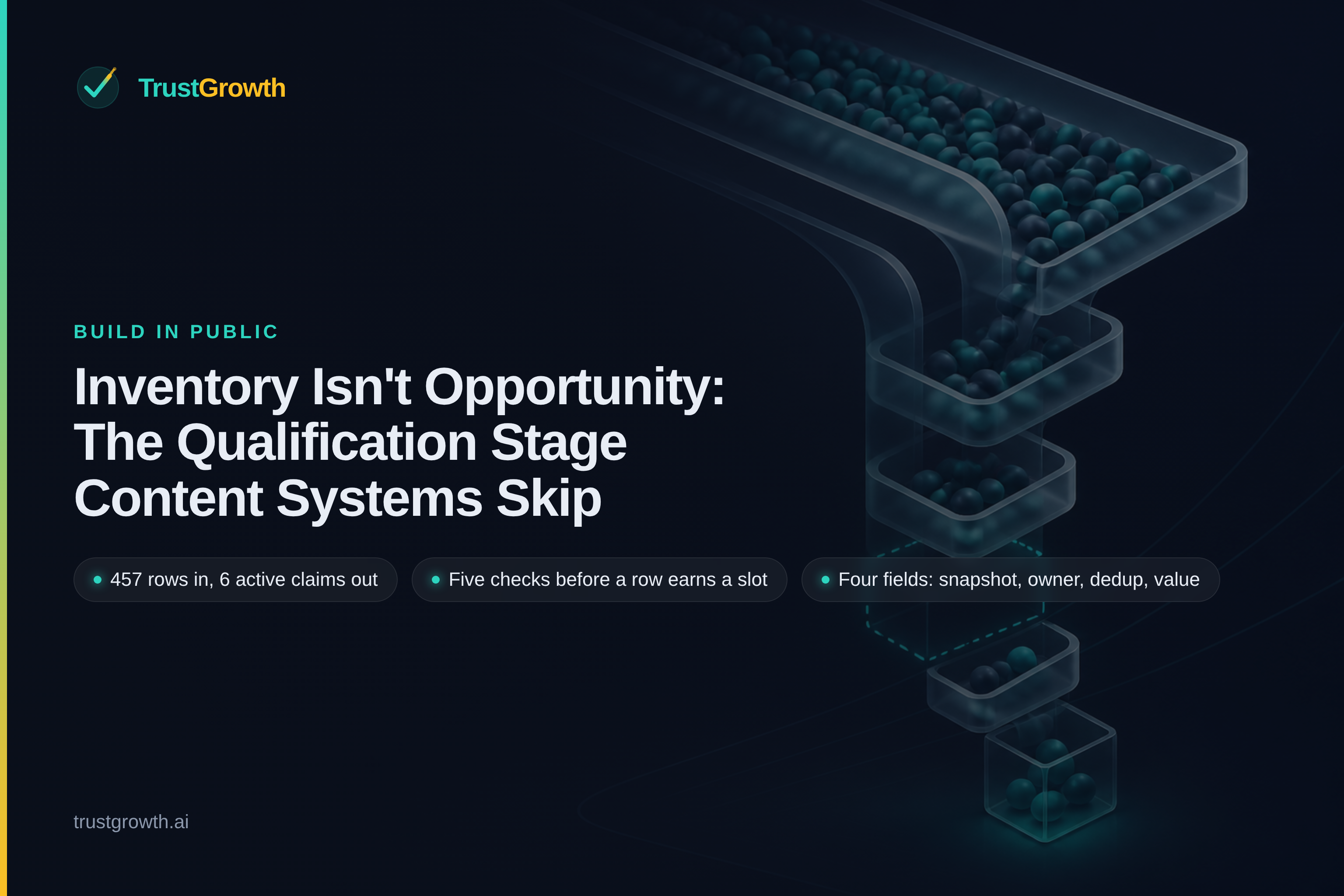
Inventory Isn't Opportunity: The Qualification Stage Content Systems Skip
457 keyword rows, 6 active claims. A sourced look at the qualification stage missing between content inventory and production, pulled 2026-08-17.
Article highlights
- Estimated reading time: 8 minutes
- Published on: August 20, 2026
- Last updated: August 20, 2026
Article
What we measured
Since 2026-07-01, TrustGrowth's internal content pipeline logged 457 keyword rows entered into its planning system, 370 calendar entries created from that inventory, 270 briefs generated, and approximately $88 spent on tooling and generation. Only 6 rows are currently active claims, meaning a row with a named owner, confirmed intent, and a current SERP snapshot on file. This piece reports that funnel as recorded on 2026-08-17, names the qualification stage missing between inventory and production, and states plainly what the data does not show.
This is part of our build-in-public series, where we publish our own pipeline numbers before we publish advice based on them. These figures are a snapshot of one internal pipeline. They are not a benchmark for other teams, not proof of content ROI, and not a Google ranking metric.
The inventory trap: why more keyword rows don't mean more opportunities
Most content teams measure activity: keyword rows added, calendar slots filled, instead of tracking how many of those rows survive to production. Inventory is any keyword row or calendar entry that entered the system, regardless of whether anyone confirmed it was worth pursuing. An opportunity, or claim, is a row that passed a qualification check: SERP snapshot reviewed, intent confirmed, owner assigned.
The gap between those two definitions is where most planning tools fail. A spreadsheet or calendar tool tracks due dates, titles, and status columns. None of those fields ask whether the row still deserves to exist. Our thesis, based on our own pipeline data below, is that the missing step is a discrete qualification stage, and most content-planning systems, including ours until recently, have no such gate.
Method: how we tracked our own pipeline since July 2026
We pulled figures directly from TrustGrowth's internal content pipeline records, not from estimates or retroactive reconstruction, on a fixed pull date of 2026-08-17.
- Data source: internal pipeline database (keyword intake table, calendar table, brief table, spend ledger)
- Sample: all rows created 2026-07-01 through 2026-08-17
- Fields tracked: keyword rows added, calendar entries created, briefs generated, claims made (owner assigned plus snapshot attached), dollars spent on tooling and generation
- Exclusions: none. This is a full count of the pipeline, not a filtered sample
- Tooling: internal database export, no third-party analytics platform involved
This is one pipeline and one team. It is not a benchmark for other systems, and we make no claim that our ratios generalize. For a precedent on naming source and method before stating a finding, see how we published our audit's underlying data points. The same claim-safety rules that govern our public score also govern this internal reporting; see how we keep our own numbers honest.
The funnel receipts: from 457 keyword rows to 6 active claims
Stage Count Unit Keyword rows entered 457 rows Calendar entries created 370 entries Entries ever claimed 55 entries Briefs produced 270 briefs Briefs without a SERP snapshot 220 briefs Active claims (current) 6 claimsSource: TrustGrowth internal content pipeline records, pulled 2026-08-17, covering 2026-07-01 to 2026-08-17 (n = 457 keyword rows). Methodology background: how we built our own scoring data points.
Note: "briefs produced" and "entries ever claimed" are not sequential stages of the same funnel. Briefs can be produced from claimed or unclaimed entries, so these two rows should be read as separate counts, not as one continuous conversion path.
Keyword inventory to active claims
Of 457 keyword rows entered since 2026-07-01, only 6 are currently active claims. The remaining 451 were filtered out for four recorded reasons: no owner assigned, unconfirmed intent, duplicate coverage against an existing published page, or manual deprioritization during triage. We did not track which of these four reasons dominated numerically, which is itself a gap in our own qualification tooling. See our current-state truth post for why we report this gap rather than smooth it over.
Calendar entries: created vs ever claimed
370 calendar entries were created in the same window; 55 were ever claimed. We define "claimed" precisely: an entry someone took ownership of in the pipeline, not necessarily one that was published or drafted. This distinction matters because a claim is a qualification event, not a production event. See our earlier post on content calendar strategy for how we originally structured the calendar fields.
Briefs missing a SERP snapshot
Of 270 briefs produced, 220 lacked a SERP snapshot at brief time (pipeline method). A SERP snapshot matters as a qualification input because it confirms live intent, active competitors, and expected format (listicle, comparison table, tool page) before a writer starts. Without it, a brief is a guess about what the SERP looked like whenever the keyword was first added to inventory, which could be weeks earlier.
Spend to date
Approximately $88 was spent since 2026-07-01 on tooling and generation across the full 457-row inventory. Set against the 457-to-6 conversion, spend is not the constraint on this pipeline. Qualification is. Even at near-zero cost per row, the system produced 451 rows that never became a claim. For related context on how we frame internal tooling spend, see the growth engine overview.
The missing stage: what qualification actually checks
Qualification is a discrete step between inventory intake and production assignment, not a quality gate applied after a draft exists. It should run five checks before a row is allowed to become a calendar entry:
- Confirmed intent match: does the keyword's actual SERP match the assumed intent, not just the string itself
- Current SERP snapshot: pulled at qualification time, not inherited from when the row was first entered
- Assigned owner and resourcing: a named person with capacity this cycle, not a placeholder
- Deduplication check: does this row overlap existing published coverage
- Stated reader value: a one-line reason this specific row is worth production cost
Intent confirmation and deduplication are the two checks that keep us from publishing unhelpful or overlapping pages; they follow Google's guidance on creating helpful, people-first content.
Most calendars today track due date, title, and status, three fields that say nothing about whether the row should exist. What gets produced once a row clears qualification is a separate question governed by the anti-slop doctrine we apply across generation steps.
A reusable qualification checklist for your own pipeline
Apply these five questions to any row before it moves from inventory to a calendar entry or claim:
- Does this row have a current SERP snapshot attached, pulled within the last qualification cycle?
- Is there a named owner who can claim it this cycle, not a TBD?
- Does it duplicate or overlap existing published content on the same intent?
- Is intent confirmed by reviewing the actual SERP, not assumed from the keyword string alone?
- Is there a stated reason this row is worth production cost, distinct from a reason it was worth listing?
A row that fails any one of these five checks stays in inventory. It does not become a calendar entry, and it does not get a brief.
What this data can't tell you (limitations)
This report contains no ranking, traffic, or revenue outcomes (pipeline method). We did not measure searchanalytics.query performance, click-through rate, or conversion for any of the 6 active claims or the 55 ever-claimed entries, and we make no claim about either.
Two limitations apply directly. First, the sample is one pipeline over one time window (2026-07-01 to 2026-08-17); the 457-to-6 ratio will shift as the pipeline continues running, and we have not re-pulled it against a second team or a second tool. Second, low claim rate correlates with missing qualification steps in this data: 220 of 270 briefs lacked a snapshot, and only 6 rows survived to active claim, but correlation is not causation. We do not claim the qualification stage causes higher content ROI, only that its absence is measurable and, in this pipeline, coincides with a low survival rate from inventory to claim (pipeline method).
These figures describe the current state of one internal system as of 2026-08-17. They should not be read as a benchmark for other pipelines or as evidence of downstream search performance. For the broader argument that internal metrics need to reflect current-state truth before they get repurposed as marketing evidence, see current-state truth before marketing assets.
Building the qualification gate into your content system
You can add a qualification stage to an existing calendar or spreadsheet without new tooling. Add four columns: snapshot_date, owner, dedup_check, and stated_value. A row does not move from your inventory tab to your calendar tab until all four are filled.
The single reusable lesson from our own 457-row pipeline: track claims and snapshots, not just rows added. A keyword row with no owner and no snapshot is not an opportunity, it is a line item. If you want to see how this qualification logic connects to the diagnostics we run on client pipelines, that is covered under content strategy diagnostics, though the checklist above works independent of any specific tool. For related measurement writeups, see more posts on content strategy measurement.
What is the content qualification stage?
It is a discrete checkpoint between keyword inventory intake and calendar or production assignment where a row must pass checks for confirmed intent, a current SERP snapshot, an assigned owner, deduplication against existing coverage, and a stated reader-value reason before it can proceed.
How is a claim different from a calendar entry?
A calendar entry is any row placed on a schedule; a claim is an entry someone has taken ownership of. In our data, 370 calendar entries were created but only 55 were ever claimed, and only 6 remain active claims (TrustGrowth internal pipeline records, pulled 2026-08-17).
Why does a SERP snapshot matter at brief time?
A snapshot confirms live intent, current competitors, and expected content format before writing starts. Of 270 briefs in our pipeline, 220 were produced without one, meaning the writer worked from assumptions rather than the live SERP.
Does spending more on content tooling fix a low qualification rate?
Not based on this data. We spent approximately $88 total across 457 keyword rows and still converted only 6 to active claims, indicating the bottleneck is the missing qualification step, not tooling cost.
Can I add a qualification stage without new software?
Yes. Adding four fields, snapshot date, owner, dedup check, stated value, to an existing spreadsheet or calendar tool is sufficient to gate rows before they reach production.
Key takeaways
- 457 keyword rows entered TrustGrowth's pipeline since 2026-07-01; only 6 are active claims, as of the 2026-08-17 pull.
- 370 calendar entries were created; 55 were ever claimed.
- 220 of 270 briefs lacked a SERP snapshot at brief time (pipeline method).
- Approximately $88 was spent on tooling; cost was not the bottleneck, qualification was.
- A qualification stage needs five checks: intent confirmation, SERP snapshot, owner, dedup, stated value.
- This data shows correlation between missing qualification steps and low claim rates, not causation, and includes no ranking, traffic, or revenue measurement. It describes one pipeline, one team, at one point in time.
Author: Ravi Yadav.
Know your site's real SEO score
Free GSC-verified audit, E-E-A-T scoring, and AI-powered content strategy.
Get Started Free