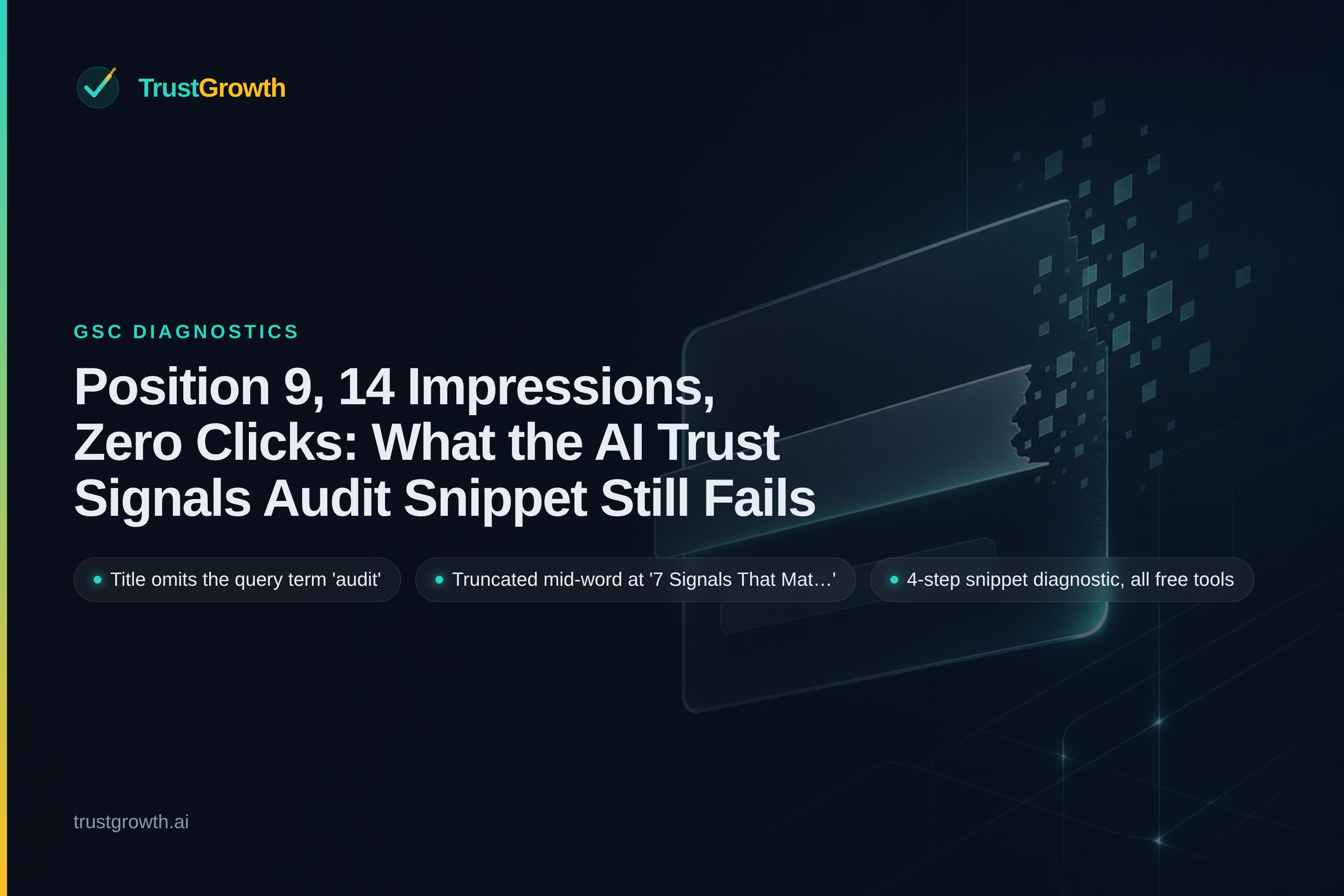
Position 9, 14 Impressions, Zero Clicks on "AI Trust Signals Audit"
An ai trust signals audit page ranks #9 with 14 impressions and 0 clicks. See the GSC data, what it proves, and a reproducible diagnostic method.
Article highlights
- Estimated reading time: 10 minutes
- Published on: August 25, 2026
- Last updated: August 25, 2026
Article
Last verified: 2026-08-24
What we found: Our page targeting the query "ai trust signals audit" holds an average position of 9 in Google Search Console, with 14 impressions and 0 clicks, according to a query-level filter in GSC's Performance report. That sample is too small to prove anything about demand or page quality on its own. This piece is a diagnosis of what those numbers do and do not show, not a report on a completed fix.
Methodology
-
Sample: 1 query ("ai trust signals audit"), 2 pages reviewed:
- Primary (GSC owning URL): AI Trust Signals for SaaS: The 7 Credibility Signals Visitors Check Before They Sign Up, published 2026-06-25, last updated 2026-06-29. This is the page GSC currently associates with the query's impressions.
- Secondary (related methodology catalogue, not the page under diagnosis): the AI Trust Signals Audit page, published 2026-08-14.
-
Tools used: Google Search Console Performance report,
view-source:on both live URLs, manual review of the live meta descriptions. - Environment: live production URLs as rendered on 2026-08-24.
- What we could not control: the 14-impression sample size, too small to compute a reliable CTR baseline. No dated Rich Results Test was run for either page, so schema eligibility is not asserted here. No dated live SERP fetch exists for this exact query, so we do not quote competitor titles.
The ai trust signals audit query and what the numbers do not prove
Position 9, 14 impressions, 0 clicks is the current first-party rationale for examining this query. It is not a completed experiment with a before and after. You can pull the same view yourself in GSC's Performance report, filtered by query then by page.
Metric Value Source Query "ai trust signals audit" GSC Performance, query filter Average position 9 GSC Performance, query filter Impressions 14 GSC Performance, query filter Clicks 0 GSC Performance, query filter CTR 0% GSC Performance, query filterFourteen impressions is a sample small enough that a single click would move CTR to 7.1%. Zero clicks at that volume tells you the snippet did not convert those 14 specific viewers. It does not tell you the topic lacks demand, and it does not tell you the underlying content is weak.
The query's owning URL is our AI trust signals piece for SaaS teams, published 2026-06-25 (last updated 2026-06-29). That is the page GSC currently associates with this query's impressions. The methodology catalogue published 2026-08-14 is a related, later asset; it is not the page those 14 searchers were shown. We have no verified separate impression count or date window for the owning URL beyond the query row above, so we report only the single set of numbers: position 9, 14 impressions, 0 clicks. We plan to refresh that page rather than rewrite from zero.
Why a page-1 snippet can still earn zero clicks
A position-9 ranking with a 0% observed CTR is diagnosable through the visible snippet, not just the ranking algorithm. Search Console's Performance report defines click-through rate as clicks divided by impressions. That is all that page states: it is a metrics-definition reference, fetched 2026-08-24, and it does not claim that title or meta copy causes the rate. The diagnosis below is ours. Ranking position and snippet fit are separate questions. If the visible title never names the query term the searcher typed, position alone will not produce the click.
We reviewed the live <title> and meta on the owning URL — the page GSC associates with these 14 impressions — as of 2026-08-24, using view-source::
Title: AI Trust Signals for SaaS: 7 Signals That Mat… — TrustGrowth
Meta: Learn the 7 AI trust signals for SaaS that visitors and AI tools check before signup, plus a practical audit checklist.
The word audit never appears in that title. The query is "ai trust signals audit"; the title the searcher can see is a SaaS explainer that stops at "7 Signals That Mat…". "Audit" survives only in the last four words of the meta description (audit checklist.). That is the primary finding: a query-to-snippet mismatch on the page that actually earned the zero clicks.
The title is also truncated mid-word (Mat…) and appends the brand suffix. The on-page H1 still carries the longer string AI Trust Signals for SaaS: The 7 Credibility Signals Visitors Check Before They Sign Up. JSON-LD headline is a third string, AI Trust Signals for SaaS: 7 Signals That Matter. og:title and twitter:title truncate the same way as the tag (AI Trust Signals for SaaS: 7 Signals That Mat…). A piece that tells you to copy the literal <title> has to quote the tag, not the H1.
The meta description is the only snippet field that contains "audit". Searchers scanning a results page see the truncated, audit-free title first. We did not capture a dated fetch of the exact SERP for this query, so we will not invent competitor title strings here, and we will not claim Google rewrote this title on the SERP. We are reporting what view-source: returns on the live owning URL.
Secondary observation: same defect class, different asset
The methodology catalogue at the AI Trust Signals Audit page, published 2026-08-14, is not the page GSC associates with this query. Those 14 searchers did not see its title. We include it only as a same-class contrast.
We reviewed its live <title> and meta as of 2026-08-24, using view-source::
Title: AI Trust Signals Audit: Signals That Fail Ver… — TrustGrowth
Meta: A real AI trust signals audit of trustgrowth.ai (2025-11-04): which signals fail verification and the exact fix-and-reverify steps for each.
That tag is truncated mid-word (Ver…) before "and How to Fix Them" reaches the searcher. Its H1 still carries AI Trust Signals Audit: The Signals That Fail Verification, and How to Fix Them, and og:title / twitter:title truncate the same way as the tag. Same three-string split (title tag / JSON-LD headline / H1), different page — not the diagnosis for the 14-impression row.
Ranking pages in this general category commonly fall into a few observed patterns: a dated guide format with a year in the title, a named proprietary score or asset, or a domain matching the query itself. Without a transcribed, dated fetch, we will not attribute specific title text to specific competing domains beyond what you can pull yourself in an incognito search.
What is still true on the live page
The owning URL, published 2026-06-25 and last updated 2026-06-29, still ranks for "ai trust signals audit" while its live <title> never contains the word audit and is truncated mid-word (Mat…). The meta description is the only snippet field that names an audit, and only in its last four words. Title tag, JSON-LD headline, and H1 are three different strings. We are not claiming the meta is deficient; we are noting the title the searcher sees does not contain the query term.
The methodology page, published 2026-08-14, shows the same class of defect on a different URL. That page is not in the 14-impression row.
We have not asserted schema eligibility either way for either page because no dated Google Rich Results Test result exists to cite. If you want to know whether your own page qualifies for an FAQ or HowTo rich result, run Google's Rich Results Test yourself and record the date.
This matches the standard we apply to our own scoring. See how we keep our own score honest for the broader doctrine of not asserting outcomes we have not measured. It is consistent with an earlier self-audit where our own authoritativeness scored 33 out of 100, published as-is rather than fixed first and reported later.
What we are not claiming
We have not shipped a rewritten title, meta, or schema for the owning URL as of 2026-08-24. We are not claiming a CTR improvement, because no post-change measurement window exists to report. We are not claiming a ranking movement, isolated or otherwise. The 14 impressions in the table above is the only impression volume we have for this query, and we have no second impression count or additional date window to compare it against. We have not measured impression trends over any longer window.
We plan to refresh the owning URL rather than rewrite it from zero. The SaaS credibility-signals page already ranks for this query, and any change should start there, informed by the missing query term in its visible title and the mid-word truncation. The methodology page is a related contrast, not the page to rewrite first.
How to diagnose your own ranked-but-clickless query
You can run this exact diagnostic on any page-1 query with an unexpectedly low CTR, using free, public tools.
- Filter GSC Performance by query, then by page. Note position, impressions, clicks, and CTR alongside the exact date range shown at the top of the report. Screenshot it with the date picker visible.
- Fetch the live SERP in an incognito window for the exact query string. Capture the full URL bar in any screenshot.
-
Run
view-source:on your live URL and copy the literal<title>and<meta name="description">tags. Google sometimes rewrites what you wrote, so compare the source against what actually renders. Diagnose the URL GSC lists for the query, not a later related page. - Optionally, run Google's Rich Results Test on the URL and record the date and result verbatim. Do not assert eligibility without this step.
All four steps are public and reproducible without TrustGrowth or any paid tool. For the full reproducible method beyond a single query, see our full GSC audit playbook.
We use GSC plus a raw fetch instead of a single proprietary score for this kind of diagnosis because a number alone cannot tell you why a snippet failed to convert an impression into a click. It can only assign a value. See how to verify whether a tool actually measured your page rather than returning an estimate it never checked. The same logic applies to any E-E-A-T number: read what a score checker can and can't verify before treating a single score as diagnostic. This case study is itself an example of the public proof pages format we build toward. If you want this diagnostic run automatically against your own property, that is what a GSC-verified audit does.
Summary: key takeaways
- Position 9, 14 impressions, 0 clicks (GSC Performance, query filter) is a small-sample signal, not proof of no demand or a bad page.
- 14 impressions is below the threshold where CTR is statistically meaningful. One click would move CTR to 7.1%.
- The owning URL's live
<title>, as of 2026-08-24, does not contain the query term "audit" and is truncated mid-word (7 Signals That Mat… — TrustGrowth). "Audit" appears only in the last four words of the meta description. - The methodology page shows the same class of title-truncation defect, but it is a later, separate asset — not the page in the 14-impression row.
- No rewrite, CTR outcome, or schema eligibility claim is made in this piece. Those require a dated after-window we do not yet have.
- You can run the full four-step diagnostic yourself with GSC, an incognito browser,
view-source:, and Google's Rich Results Test.
FAQ
Why does a page rank at position 9 for "ai trust signals audit" but get zero clicks?
Position alone does not determine clicks. The visible snippet, meaning the title, meta description, and any rich result, does. A snippet that does not clearly match the searcher's implied intent will underperform even at a reasonable ranking position. In this case the owning URL's live <title> never contains the word "audit" and is truncated mid-word (Mat…) before it finishes "Matter."
Is 14 impressions enough to diagnose a CTR problem?
No. Per the GSC query-filter data above, 14 impressions is too small a sample to establish a reliable CTR baseline. A single click swings the rate by more than 7 percentage points. Treat findings at this volume as directional only.
Does adding FAQ or HowTo schema guarantee more clicks or a rich result?
No. Schema only makes a page eligible for a rich result. Google decides whether to render it. Confirm eligibility with a dated Rich Results Test run, not an assumption.
Should I rewrite the methodology page or the current owning URL first?
Start with the owning URL, since that is the page GSC currently associates with this query. Treat the methodology page as a related, separate asset.
Limitations
This analysis is based on a single query with 14 impressions, too small a sample for any CTR conclusion. We have no second impression count, no date range beyond the current live-page dates cited (owning URL published 2026-06-25, last updated 2026-06-29; methodology page published 2026-08-14), and no dated Rich Results Test for either page. No competitor title strings are quoted because we did not fetch and transcribe a dated live SERP for this exact query.
Verify this yourself
Pull the same query filter in your own GSC property, screenshot the date range and the four metrics, then run view-source: on the URL GSC lists for that query — not a later related page. Compare what you find against a page you consider well-optimized and note the concrete difference in what each title and meta promises.
Know your site's real SEO score
Free GSC-verified audit, E-E-A-T scoring, and AI-powered content strategy.
Get Started Free