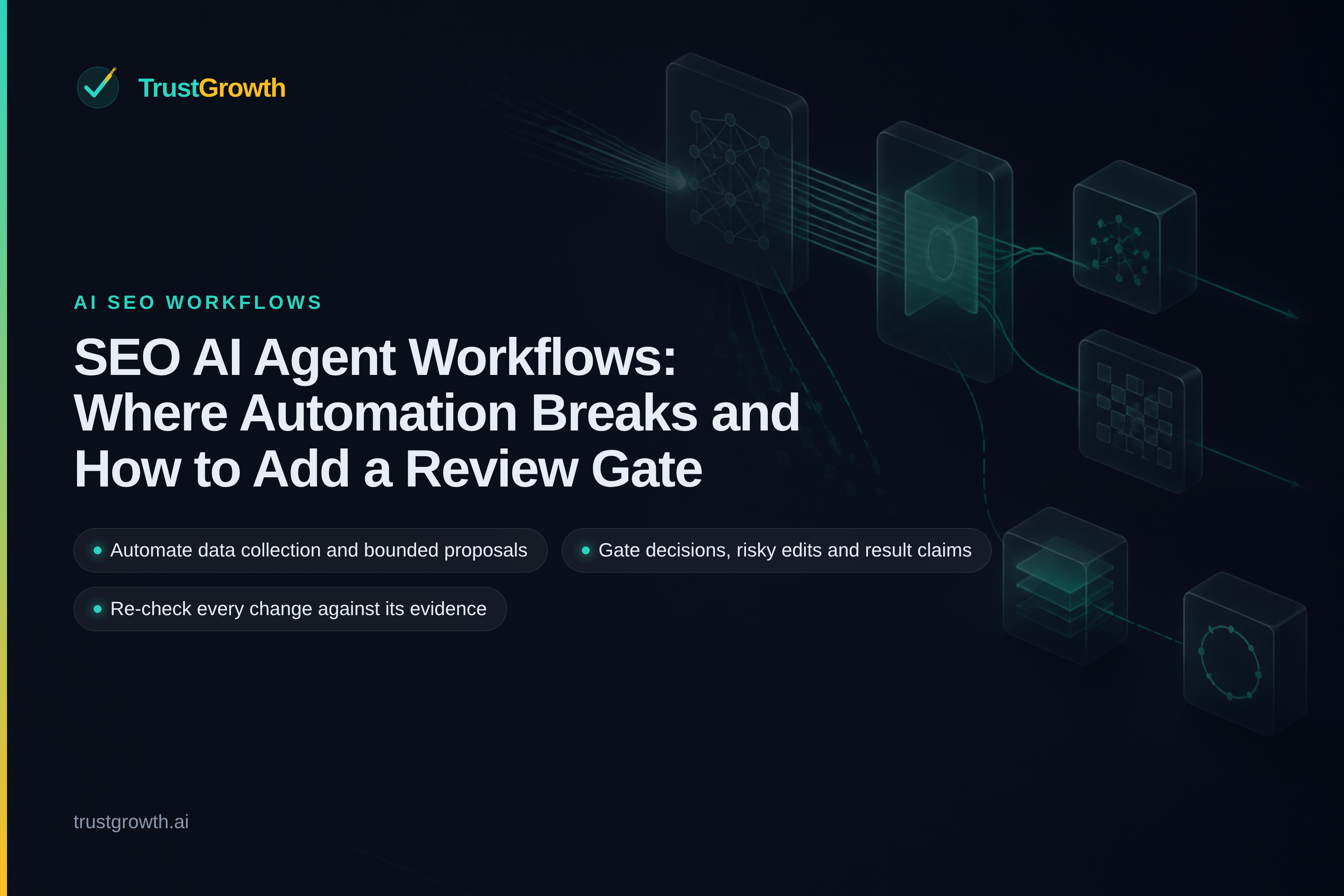
SEO AI Agent Workflows: Where Automation Breaks and How to Add a Review Gate
Learn where an SEO AI agent breaks, what it can safely automate, and how to build a review gate with evidence, rollback, human review, and post-change verification.
Article highlights
- Estimated reading time: 10 minutes
- Published on: October 25, 2026
- Last updated: October 25, 2026
Article
What we measured
- Method: workflow analysis focused on access, evidence, change control, and verification.
- Sample: one-site evaluation protocol for founders testing an SEO AI agent.
- Date range: not applicable; this is a reusable operating framework, not a ranking experiment.
- Headline result: an SEO AI agent can automate collection and bounded proposals, but it cannot safely prove that a change is correct without evidence and human review.
If you are an indie or technical founder, the difficult question is not whether an SEO AI agent can generate an audit. It is whether the system actually inspected your site, used first-party data, and verified its conclusions.
An SEO AI agent is a system that observes SEO inputs, chooses or recommends actions, uses connected tools, and iterates toward a search-growth objective. It is more autonomous than a chatbot prompt or fixed automation, but autonomy does not prove that its inputs or conclusions are correct.
The operating rule is simple: automate data collection and bounded proposals; gate decisions, risky edits, and claims about results. This distinction matters when an agent connects to Google Search Console, Google Analytics, Screaming Frog, Ahrefs, Semrush, GitHub, or a content management system.
What is an SEO AI agent?
An SEO AI agent is a system that observes search data and website conditions, uses tools such as Google Search Console or a crawler, recommends or executes bounded actions, and repeats checks against a defined objective. Unlike a one-off ChatGPT prompt, it can coordinate multiple steps; unlike conventional automation, it can choose a next action from its observations. That autonomy still requires source evidence and human review.
What can an SEO AI agent automate?
An SEO AI agent can connect a sequence of tasks that would otherwise require separate tools. A typical workflow collects site and Search Console data, classifies problems, prioritizes opportunities, drafts changes, executes approved actions, re-checks the result, and records what happened.
Useful applications include:
- Query clustering from Google Search Console data.
- Technical triage for canonicals, status codes, sitemaps, and
robots.txt. - Internal-link suggestions based on page relationships.
- Content briefs, title drafts, and meta descriptions.
- Schema.org checks against visible page content.
- Server-log analysis and crawler monitoring.
- Change monitoring across important URLs.
The key boundary is between read operations and write operations. Google’s Search Console Performance report documentation describes performance data such as queries, pages, clicks, impressions, and average position. Read-only access can support diagnosis, but it does not prove that a recommendation improved rankings, conversions, or visibility in AI answers.
| Task | Useful automation | Evidence required | Review level |
|---|---|---|---|
| Query clustering | Group queries by intent and page | Query, impressions, position, and URL | Review recommended targets |
| Metadata drafting | Produce title and description options | Page content and search intent | Human approval |
| Technical triage | Find status, canonical, or indexability conflicts | URL response and crawl timestamp | Review before edits |
| Internal links | Suggest relevant source and destination pages | Page text and destination purpose | Review each change set |
| Canonical or robots edit | Prepare a bounded diff | Exact URLs and deployment context | Explicit approval |
| Monitoring | Re-run checks after deployment | Before/after records and test scope | Verify and report limits |
For a broader framework, use this capability test for AI-powered SEO tools. A first-party real detect-to-verify SEO agent run can illustrate one workflow, but one case does not generalize to every site.
Where autonomous SEO workflows break
1. Incomplete inputs produce false certainty
An agent may receive a stale crawl, partial coverage, sampled Search Console rows, inaccessible URLs, or third-party estimates from Ahrefs or Semrush. “No data” must not become “no problem.”
Require every finding to carry one status: measured, inferred, blocked, or unknown. A Google Search Console connection proves that a connection exists; it does not prove that every relevant URL or query was examined. See what Google Search Console query data can and cannot prove.
2. Inventory is not opportunity
A keyword list is an inventory, not a growth plan. Before an agent recommends a new page, require the query, impressions, position, search intent, business relevance, and page-level evidence.
Search Console reports how pages and queries performed within its reporting scope; it does not independently establish that a proposed topic will produce qualified conversions. Google documents the report’s available metrics and dimensions in its Performance report reference. Publishing a page for every discovered keyword can create near-duplicate content and competing pages.
3. Correlation is not causation
A ranking movement after deployment does not prove that the deployment caused the movement. Require a timestamped before-and-after record, affected URL set, comparison period, and plausible mechanism.
Search Console can report performance data and support comparison, but its report does not isolate every cause of a click, impression, or position change. Treat “the fix worked” as a hypothesis until the relevant check is repeated and its limits are recorded.
4. Unsafe edits can damage indexing
Canonical changes, noindex directives, redirects, robots.txt rules, internal-link rewrites, schema, and bulk content edits require high review. A syntactically valid change can still block crawlers, deindex valuable pages, create redirect chains, duplicate intent, or mark up content that is not visible on the page.
Google’s documentation explains the roles of robots.txt, canonicalization, and structured data. An agent should return the exact diff, affected URLs, expected outcome, and rollback method. A successful deployment is not proof of a successful SEO outcome.
5. Fabricated evidence looks like expertise
An agent can produce a confident explanation without fetching the page, querying Search Console, or validating deployment. Require source URLs, timestamps, request and response evidence, exact queries, and commands used.
TrustGrowth’s measurement-first approach is useful here: connect Google Search Console in read-only mode, inspect evidence behind technical, performance, content, and inferred E-E-A-T findings, and treat the resulting score as a diagnostic—not a Google ranking factor.
6. “Done” is not a verification state
A merged pull request, submitted sitemap, or accepted URL Inspection request does not prove ranking improvement. Google describes URL Inspection as a way to inspect a URL’s indexed state and testing options, not as a guarantee of a ranking outcome; see the URL Inspection tool documentation.
Completion should mean:
- Detect the issue.
- Propose a bounded change.
- Approve the scope and risk.
- Deploy the change.
- Re-check the relevant condition.
- Report results, failures, and unknowns.
Read what a passed GSC validation actually confirms before treating validation as a universal success signal.
How to build a review gate for an SEO AI agent
A review gate is a documented decision point between an agent’s proposal and an irreversible or high-impact action. The model below separates observation from judgment.
- Observe: collect only authorized data. Record the source, date, scope, permissions, and coverage.
- Diagnose: distinguish direct measurements from inferences. Label missing or blocked inputs.
- Propose: generate a bounded change with an expected outcome and rollback plan.
- Review: require a person to approve the claim, scope, risk, and user intent.
- Verify: re-run the relevant test and publish the result, including failures and unknowns.
Each approval record should include affected URLs, the exact diff, evidence and source queries, risk class, expected metric or observable condition, observation window, rollback method, approver, and decision timestamp.
Use three risk tiers. Automatic read-only tasks include crawling, reporting, clustering, and monitoring. Review-required tasks include content edits, metadata changes, and internal-link changes. Explicit approval is required for canonicals, robots.txt, redirects, indexing controls, and production deployment.
Treat approval as an evidence-based question, not as a button that converts an uncertain recommendation into a fact.
Copyable review prompt
What did the agent directly measure?
What is inferred, blocked, or unknown?
Which URLs and queries are affected?
What could this change break?
What is the exact diff and rollback method?
What test will falsify the recommendation?
What will be re-checked after deployment?
How to test an SEO AI agent on one site
Use one site and one proposed change. Record the site URL, agent name and version, connected tools, permissions, prompt, crawl date, sample size, and output. This creates a reproducible baseline rather than a vendor claim.
Test four capabilities:
- Access verification: Can the agent show that it reached the site and connected data source?
- Diagnosis accuracy: Does each finding include the exact URL or query behind it?
- Change safety: Is the proposal reversible, scoped, and technically valid?
- Post-change verification: Does the agent repeat the relevant check and state what remains unknown?
Compare the output with first-party Google Search Console data and a manual page check. Use this scorecard without collapsing it into an unexplained overall score:
| Capability | Pass condition |
|---|---|
| Reached the source | The agent provides fetch, crawl, or connection evidence |
| Cited evidence | Each finding links to a URL, query, response, or sample |
| Separated known from inferred | Uncertainty labels appear in the output |
| Proposed a reversible action | Scope and rollback are explicit |
| Passed re-check | The relevant condition was tested after the change |
You can also tell whether an SEO tool actually measured your site. TrustGrowth can provide a Google Search Console-verified audit and site-specific public proof snapshot as an example of evidence-led diagnosis. An audit is not a guarantee of rankings.
What should you look for when evaluating an SEO AI agent?
Evaluate capabilities, not an unscoped “best” vendor label. Check permissions, source provenance, crawl coverage, change control, rollback, validation, audit logs, uncertainty labels, and exportable outputs. This is the same boundary explored in TrustGrowth’s inspectable SEO workflow skills.
Ask these questions before buying or connecting an agent:
- Can it prove that it fetched the site?
- Can it show the exact sample behind a finding?
- Does it distinguish a recommendation from an executed change?
- Can you reject one action without stopping the full workflow?
- Does it preserve the prompt, tool version, timestamp, and output?
- Can it re-run the same check after deployment?
ChatGPT can do SEO when you provide reliable inputs. It can analyze exports, cluster keywords, draft content, and write tests or shell commands. It cannot independently prove that it crawled your site, accessed private Search Console data, or caused a ranking improvement unless those steps are connected, recorded, and verified.
Frequently asked questions about SEO AI agents
What are AI agents in SEO?
AI agents in SEO are systems that observe SEO data, recommend or choose actions, use connected tools, and iterate toward a defined objective. They are more autonomous than one-off ChatGPT prompts, but autonomy does not prove that their inputs or conclusions are correct.
Is there an AI that can do SEO?
Yes. AI systems can automate research, clustering, technical triage, content briefs, drafts, monitoring, and bounded changes. Trustworthy use depends on access verification, evidence quality, approval controls, and post-change validation.
Can ChatGPT do SEO?
ChatGPT can analyze supplied data, suggest keywords, draft content, and help write tests. It cannot prove that it measured a private site or improved rankings without connected tools, recorded evidence, and a valid verification process.
Which AI agent is best for SEO?
There is no unscoped best SEO AI agent. Compare systems by access verification, provenance, crawl coverage, risk controls, rollback, audit logs, uncertainty labels, and validation against first-party data.
Is SEO going away with AI?
AI changes discovery and workflow execution, but sites still need crawlable pages, useful information, technical accessibility, credibility, and evidence of business impact. Visibility in search or AI answers is not the same as traffic or conversions.
What is AI SEO called now?
Terms include AI SEO, SEO automation, generative-engine optimization, and AI visibility work. Terminology is inconsistent, so define the specific outcome and measurement method instead of relying on the label.
Can a beginner do SEO with an AI agent?
Yes, a beginner can use an agent for low-risk research and structured checks. Start with read-only access, review every recommendation, use reversible changes, and never allow unreviewed edits to canonicals, robots.txt, redirects, or indexing controls.
Limits of this analysis
This framework cannot show which agent will improve your rankings, traffic, conversions, or AI citations. It does not compare vendor performance on a shared crawl, because no such experiment was supplied. It also cannot establish causation from a single before-and-after movement or guarantee that an agent’s external data is complete.
Conclusion: automate proposals, gate decisions
An SEO AI agent is useful when it makes evidence collection and bounded proposals faster. It becomes unsafe when plausible language replaces source access, uncertainty labels, review, rollback, and re-checking.
Use the five-stage sequence: observe, diagnose, propose, review, and verify. Record the URLs, queries, permissions, exact diff, risk, expected metric, and result. Then run a GSC-verified TrustGrowth audit and inspect the evidence behind the resulting score and recommendations.
Know your site's real SEO score
Free GSC-verified audit, E-E-A-T scoring, and AI-powered content strategy.
Get Started Free